
The 8th Pay Commission 2026 has sparked immense interest among millions of government workers and retirees in India. Following the successful rollout of the 7th Pay Commission, which delivered substantial salary boosts and enhanced perks, anticipation is building for the next round of revisions. For active public servants and those in retirement, these updates promise to bolster economic stability amid rising costs.
Table of Contents
What Is the 8th Pay Commission?
Established by the Indian government, the Pay Commission periodically assesses and suggests overhauls to the compensation system for public sector staff. The 8th Pay Commission, officially formed in early 2026 under the leadership of Ranjana Prakash Desai, is tasked with this review. While full implementation awaits the panel’s report (due in about 18 months), changes are expected to apply retroactively from January 1, 2026, including arrears. This could affect over 1 crore central government employees and pensioners, factoring in elements like inflation rates, living expenses, GDP growth, and budgetary constraints for a fair pay system.
Benefits After the 8th Pay Commission
Post-8th Pay Commission benefits aim to align earnings with contemporary economic realities, emphasizing sustainable income growth and security. Key focuses include elevating base salaries, updating allowances like House Rent Allowance (HRA) and Dearness Allowance (DA)—which has climbed to around 60% as of January 2026—refining pension formulas, and upgrading retirement perks such as gratuity and encashable leaves.
8th Pay Commission Benefits for Central Government Employees
Central government staff stand to gain the most from the 8th Pay Commission salary hike 2026. The revamped pay matrix could introduce higher starting pays, smoother grade advancements, and refined allowance packages. Additional enhancements might cover housing subsidies, transport reimbursements, and healthcare coverage, with a projected fitment factor of 2.8-3.0 potentially boosting overall take-home by 25-35%.
8th Pay Commission Benefits for State Government Employees
While not mandatory, many states are likely to mirror the 8th Pay Commission recommendations, as seen in past cycles. Employees in states like Uttar Pradesh, West Bengal, and Andhra Pradesh could see adapted pay scales, with delays varying by local finances. Benefits may encompass revised DA mergers, improved allowances, and state-specific incentives, promoting pay parity across regions.
8th Pay Commission Benefits for Bank Employees
Bank staff operate under bipartite settlements via the Indian Banks’ Association (IBA), separate from the Pay Commission. However, the 8th Pay Commission latest updates could indirectly shape upcoming wage talks, leading to better retirement packages, performance bonuses, and working conditions. Unions may push for alignment to address disparities.
8th Pay Commission Benefits for SBI Employees
SBI personnel follow the same IBA framework, so direct 8th Pay Commission applicability is limited. That said, parity pressures and negotiations could result in indirect gains, such as enhanced pensions, risk allowances, and service perks, drawing inspiration from central revisions.
8th Pay Commission Benefits for PSU Employees
Public Sector Undertakings (PSUs) typically align with government pay guidelines. The 8th Pay Commission could usher in salary increments, better provident fund contributions, and performance-based rewards for PSU workers. Some entities might also revise bonus structures and long-term incentives post-report.
8th Pay Commission Benefits for Defence Personnel
Military members from the armed forces are poised for targeted upgrades under the 8th Pay Commission. Anticipated perks include boosted Military Service Pay, specialized allowances for high-risk duties, and strengthened disability pensions, ensuring comprehensive support for serving and veteran personnel.
8th Pay Commission Benefits for Army Personnel
Army staff may benefit from tailored adjustments, such as increased field and special duty allowances, anti-insurgency bonuses, and liberalized leave policies. The commission could also focus on ex-servicemen’s pensions, addressing demands for better post-retirement financial aid.
8th Pay Commission Benefits for Agniveer
Under the Agnipath scheme, Agniveers’ status in the 8th Pay Commission remains under review. Potential outcomes include clearer pathways for permanent roles, enhanced exit packages, and financial safeguards, influenced by ongoing talks on service extensions and benefits.
8th Pay Commission Benefits for GDS Employees
Gramin Dak Sevaks (GDS) have advocated for inclusion in regular pay frameworks. The 8th Pay Commission might yield wage parity, improved insurance, and security measures, responding to calls for equitable treatment beyond current ad-hoc systems.
8th Pay Commission Benefits for Private Employees
Private sector workers aren’t covered directly, but public pay hikes often ripple outward. Companies in competitive fields like tech, finance, and consulting may raise salaries to attract talent, fostering market-wide adjustments for skilled professionals.
8th Pay Commission Benefits for Pensioners
Retirees are set for notable relief through the 8th Pay Commission pension revision. Expectations include uplifted basic pensions, synchronized Dearness Relief (DR) hikes, and family pension tweaks to counter inflation and medical costs effectively.

8th Pay Commission Benefits for Central Government Pensioners
Central pensioners could see pensions recalibrated via the new matrix, with higher gratuity caps and expanded health schemes. Arrears from January 1, 2026, would provide a backlog boost, enhancing overall retirement support.
8th Pay Commission Benefits for State Government Pensioners
Adopting states may offer pension updates, including DR alignments and commutation reforms. Variations depend on fiscal health, but many aim to bridge gaps for state retirees.
8th Pay Commission Benefits for Existing Pensioners
To tackle inequalities, the 8th Pay Commission fitment factor could enable revisions for pre-2026 retirees, incorporating better redressal and equitable adjustments.
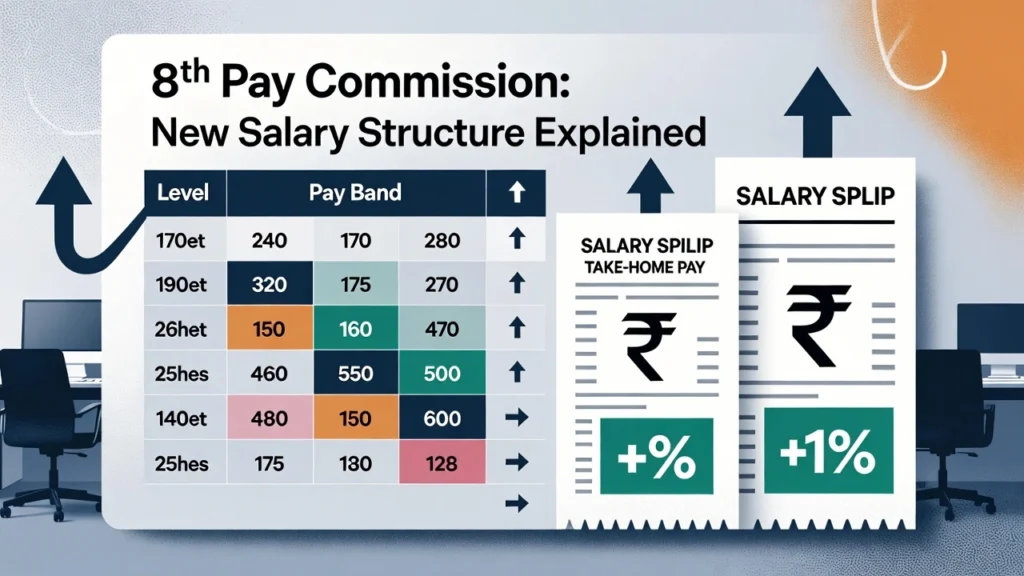
Projected Salary Revision Table (Indicative Based on 2026 Estimates)
| Pay Level | Current Basic Pay | Expected Basic Pay (Post-8th CPC) | Approx. Hike (%) |
|---|---|---|---|
| Level 1 | ₹18,000 | ₹30,000+ | 35-40% |
| Level 4 | ₹25,500 | ₹42,000 | 32-35% |
| Level 6 | ₹35,400 | ₹58,000 | 30-35% |
| Level 10 | ₹56,100 | ₹92,000 | 30-35% |
| Level 13A | ₹1,31,100 | ₹2,15,000 | 28-32% |
These are projections based on a fitment factor of 2.8-3.0; actuals await official approval.
FAQs (Frequently Asked Questions)
When will the 8th Pay Commission be implemented?
Full rollout is expected after the panel’s report in mid-2027, but effective from January 1, 2026, with arrears.
How much pension may increase after the 8th Pay Commission?
Pensions could rise 25-35% via fitment factor, plus DR hikes, depending on final recommendations.
How much salary increase is expected under the 8th Pay Commission?
Estimates suggest 25-40% overall, driven by base pay boosts and allowance mergers.
What is the likely impact on employee benefits?
Enhanced allowances, pensions, and perks could improve financial security, with ripple effects on recruitment and retention.
What is the current status as of January 2026?
Commission is active and reviewing. Salaries & pensions still under 7th CPC rules (DA around 58-60%). No new pay/pension yet – await final recommendations.
What is the expected fitment factor?
Projections: 1.83–2.57 (some reports say up to 2.46). Unions demand higher (2.8–3.0+). Final figure will decide the overall hike.
Will there be arrears from January 1, 2026?
Yes – highly likely (as per past commissions). If implementation delayed, arrears for the period from Jan 1, 2026 will be paid in lump sum.
Will DA/DR be merged with basic pay?
No current plan for merger. DA/DR will reset to 0% on new basic pay after fitment (same as 7th CPC).
Is 8th Pay Commission applicable to state employees/pensioners?
Not directly. States usually adopt central recommendations (with some delay/modifications) as seen in previous commissions.
Stay tuned for official 8th Pay Commission notifications to get the latest on these developments.