
📊 8th Pay Commission Salary Calculator (Updated 2026)
Salary Comparison
7th Pay Commission
Gross Salary: ₹
Net Salary: ₹
8th Pay Commission (Projected)
Gross Salary: ₹
Net Salary: ₹
Gross Increase: %
Net Increase: %
Detailed Breakdown
| Component | 7th CPC |
|---|---|
| Basic Pay | ₹ |
| DA (%) | ₹ |
| HRA | ₹ |
| Total Transport Allowance | ₹ |
| Gross Salary | ₹ |
| NPS (10%) | -₹ |
| CGHS etc. | -₹250 |
| Net Salary | ₹ |
| Component | 8th CPC (Projected) |
|---|---|
| New Basic Pay | ₹ |
| DA (0% initially) | ₹0 |
| New HRA | ₹ |
| Total Transport Allowance | ₹ |
| Gross Salary | ₹ |
| NPS (10%) | -₹ |
| CGHS etc. | -₹250 |
| Net Salary | ₹ |
8th Pay Commission Salary Calculator — Estimate Your Revised Pay Instantly
Compare your current 7th CPC salary with projected 8th Pay Commission salary. Calculate Basic Pay, DA, HRA, TA, NPS deductions, and Income Tax — all in one place.
What Is the 8th Pay Commission Salary Calculator?
The 8th Pay Commission Salary Calculator is a free, comprehensive planning tool designed for Indian government employees who want to understand exactly how the upcoming pay revision will affect their monthly earnings. Built on the framework of the 7th Central Pay Commission, this tool projects your salary under the expected 8th CPC recommendations by applying a user-selectable fitment factor to your current Basic Pay.
When you enter your grade pay level, pre-revised basic salary, and HRA classification, the calculator instantly computes your new basic pay, Dearness Allowance, House Rent Allowance, Transport Allowance, NPS deduction, CGHS contribution, and estimated income tax liability. It then shows you a clear percentage increase from your current 7th Pay Commission salary to the projected 8th CPC salary.
The tool is particularly useful for scenario testing — you can adjust the fitment factor between 1.92 and 2.86, toggle HRA allowance percentages across city categories, and see how different commission outcomes affect your net take-home and pensionable amount. Whether you are planning a home loan, timing retirement, or simply understanding your financial stability post-revision, this calculator gives you a rational picture well before the official 8th CPC recommendations are published.
8th Pay Commission — Latest Updates
The Government of India officially approved the formation of the 8th Pay Commission on January 16, 2025, as announced by Union Minister Ashwini Vaishnaw. The Union Cabinet formally approved the Terms of Reference on October 28, 2025, and the commission was officially constituted through a notification in the Gazette of India on November 3, 2025.
Employee organizations and the FNPO have been demanding a fitment factor of 2.86, which would translate to a 30–34% increase in salaries and pensions. Based on current estimates, minimum basic pay is expected to jump from ₹18,000 to at least ₹30,000–₹35,400. The commission's report is expected within 18 months, after which government approval and implementation will follow. In case of any delay beyond January 1, 2026, arrears will be paid retroactively to all eligible Central Government departments, and the revision will likely be adopted by State Governments and Public Sector Undertakings (PSUs) thereafter.
How Does the 8th Pay Commission Salary Calculator Work?
The calculator takes six key inputs from you and processes them through the standard salary formula used across all Central Government pay structures. Here is exactly how to use it, step by step:
- Select Your Pay Level (Grade Pay Level)Choose your current pay level from Level 1 to Level 18 as per the 7th CPC pay matrix. This determines your pay level bracket and corresponding Transport Allowance slab.
- Enter Your Pre-Revised Basic SalaryEnter your current basic salary (your 7th CPC Stage as of December 2025). This is the foundation on which the fitment factor will be applied to arrive at your revised Basic Pay.
- Choose the Fitment FactorSelect or adjust the expected fitment factor. The default is set at 1.92 for a conservative estimate. You can test scenarios up to 2.86 to see the maximum projected salary increase.
- Select Your HRA City ClassChoose your posting location category: X city (metros like Delhi, Mumbai, Bengaluru), Y city (Tier 2 cities like Jaipur, Lucknow, Ludhiana), or Z city (all other towns). This directly affects your HRA amount.
- Click Calculate — View Your Complete Salary BreakdownInstantly see your projected 8th CPC salary — new basic pay, DA, HRA, TA, NPS deduction, CGHS, income tax, gross salary, and net take-home — compared side by side with your current 7th Pay Commission salary.
Formula Used in the 8th Pay Commission Calculator
DA = New Basic Pay × DA Rate ÷ 100 (reset to 0% on implementation)
HRA = New Basic Pay × HRA Rate ÷ 100 (X: 30% | Y: 20% | Z: 10%)
TA = Fixed Amount (by pay level & city) + DA on TA
NPS Deduction = 10% × (Basic Pay + DA)
CGHS = Fixed by Pay Level (₹250 – ₹1,000)
New Gross Salary = New Basic + DA + HRA + TA
Net Take-Home = Gross Salary − NPS − CGHS − Income Tax
When DA is at 61% on the date of implementation (as projected for 1.1.2026), it merges into the basic pay and resets to zero. This means the real-term increase in your salary is actually around 14% over the combined current salary + DA figure — though the headline percentage increase (20–34%) appears larger because it is calculated on base pay alone before DA merger.
Expected 8th CPC Salary — Pay Level Wise Comparison
The table below shows projected basic pay at three fitment factor scenarios across Level 1 to Level 14. Note that DA will be reset to 0% on implementation; the gross salary column assumes this DA merger has occurred. All figures are estimated calculations based on current assumptions and are not official government announcements.
| Pay Level | 7th CPC Basic Pay | At 1.92x | At 2.28x | At 2.86x | % Rise (at 1.92x) |
|---|---|---|---|---|---|
| Level 1 | ₹18,000 | ₹34,560 | ₹41,040 | ₹51,480 | +92% |
| Level 2 | ₹19,900 | ₹38,208 | ₹45,372 | ₹56,914 | +92% |
| Level 3 | ₹21,700 | ₹41,664 | ₹49,476 | ₹62,062 | +92% |
| Level 4 | ₹25,500 | ₹48,960 | ₹58,140 | ₹72,930 | +92% |
| Level 5 | ₹29,200 | ₹56,064 | ₹66,576 | ₹83,512 | +92% |
| Level 6 | ₹35,400 | ₹67,968 | ₹80,712 | ₹1,01,244 | +92% |
| Level 7 | ₹44,900 | ₹86,208 | ₹1,02,372 | ₹1,28,414 | +92% |
| Level 8 | ₹47,600 | ₹91,392 | ₹1,08,528 | ₹1,36,136 | +92% |
| Level 9 | ₹53,100 | ₹1,01,952 | ₹1,21,068 | ₹1,51,866 | +92% |
| Level 10 | ₹56,100 | ₹1,07,712 | ₹1,27,908 | ₹1,60,446 | +92% |
| Level 11 | ₹67,700 | ₹1,29,984 | ₹1,54,356 | ₹1,93,622 | +92% |
| Level 12 | ₹78,800 | ₹1,51,296 | ₹1,79,664 | ₹2,25,368 | +92% |
| Level 13 | ₹1,23,100 | ₹2,36,352 | ₹2,80,668 | ₹3,52,066 | +92% |
| Level 14 | ₹1,44,200 | ₹2,76,864 | ₹3,28,776 | ₹4,12,412 | +92% |
Key Components of the 8th CPC Salary Structure
Understanding each component of your salary is essential before using any salary estimation tool. The 8th CPC salary structure is built on the same foundational pillars as the 7th Pay Commission, with revised amounts and updated rules.
📌 Basic Pay — The Salary Foundation
Basic Pay is the core of your salary structure, determined by your position in the government pay matrix. Under the 7th CPC (2016), the pay matrix was introduced to replace grade pay. Now under 8th CPC, a revised pay matrix will apply a fitment factor of 1.92x to 2.86x on existing pay levels. For instance, an employee at Level 10 with a current basic of ₹56,100 would see their basic rise to approximately ₹1,07,712 at 1.92x, or up to a projected maximum with higher fitment. Every other allowance — DA, HRA, TA, NPS — is calculated as a percentage of this basic pay.
🔄 Dearness Allowance (DA) — Inflation Adjustment
Dearness Allowance is a cost-of-living adjustment paid biannually to compensate for inflation as tracked by the Consumer Price Index (CPI). The Ministry of Finance revises DA rates every six months based on CPI data. Currently at 58–61%, DA is calculated using the formula: DA = Basic Pay × Rate ÷ 100. On the date of 8th CPC implementation, DA is expected to merge into basic pay and reset to 0%, just as it happened with the 7th Pay Commission. The biannual DA revision cycle then restarts from zero, with the first revision expected within 6 months of the new pay structure going live.
🏠 House Rent Allowance (HRA) — City-Based Component
House Rent Allowance is linked to the DA rate and varies based on your posting location. Under the 8th CPC, HRA is expected to be recalculated on the revised new basic pay at the following rates: X-Class cities (metros): 30%, Y-Class cities (Tier 2): 20%, and Z-Class cities (Tier 3 and others): 10%. When DA crosses 50%, HRA for X cities rises to 30%, for Y cities to 20%, and for Z cities to 10%. After the DA reset on implementation, these rates may temporarily fall back to lower slabs before stepping back up as DA increases again.
✈️ Transport Allowance (TA) — Commuting Support
Transport Allowance is a fixed monthly amount provided to cover commuting costs. It varies by pay level and city category, with employees in Level 9 and above in major cities receiving ₹7,200 plus DA on TA, while those at lower levels in smaller towns receive anywhere from ₹900 to ₹3,600. The dual benefit of TA includes the base fixed amount and an additional Dearness Allowance on TA, which together help offset daily travel costs. TA rates will be proportionally revised under the 8th CPC.
🧓 NPS / UPS Contribution — Retirement Planning
For all central government employees appointed on or after January 1, 2004, the National Pension System (NPS) applies. The employee contributes 10% of Basic Pay + DA monthly, which is deducted from salary. The government also makes a matching employer contribution. In April 2025, the Unified Pension Scheme (UPS) was introduced as an alternative, offering a guaranteed 50% pension after 25 years of service — unlike the market-linked NPS. Under the 8th CPC, UPS rules may be further strengthened, giving employees a choice between NPS contributions and guaranteed pension benefits.
🧾 Income Tax — New Regime FY 2025-26
Income tax is calculated on your annual gross income using the applicable tax slabs for FY 2025-26. Under the new tax regime, a standard deduction of ₹75,000 is available, and annual income up to ₹12,75,000 is effectively tax-free after applicable rebates. TDS is deducted monthly from your salary. The calculator uses the new regime slabs by default: 5% on income from ₹4,00,001–₹8,00,000; 10% from ₹8,00,001–₹12,00,000; 15% from ₹12,00,001–₹16,00,000; 20% from ₹16,00,001–₹20,00,000; 25% from ₹20,00,001–₹24,00,000; and 30% above ₹24,00,000 for AY 2026-27.
🏥 CGHS & Special Allowances
The Central Government Health Scheme (CGHS) provides comprehensive healthcare benefits to employees and their families. A monthly contribution is deducted based on pay level: ₹250 for Level 1–5, ₹450 for Level 6, ₹650 for Level 7–11, and ₹1,000 for Level 12 and above. In addition to standard components, certain roles attract Special Allowances: medical professionals receive a Non-Practising Allowance (NPA) of up to 20% of basic pay, while hospital staff may receive HPCA (Hospital Patient Care Allowance) ranging from ₹4,100 at Level 8 to ₹5,300 at Level 9. Teachers, defence personnel, and those in hazardous duties also have role-based supplements that the calculator accounts for.
Salary Calculation — Step-by-Step Example
Here is a real-world example showing how the 8th CPC salary calculation works for a Level 1 employee posted in a Y-Class city:
| Component | 7th CPC (Current) | 8th CPC (Projected at 1.92x) |
|---|---|---|
| Basic Pay | ₹18,000 | ₹34,560 |
| Dearness Allowance (DA) | ₹10,980 (61%) | ₹0 (Reset to 0%) |
| HRA (Y-Class, 20%) | ₹3,600 | ₹6,912 |
| Transport Allowance + DA | ₹1,350 + DA | Revised proportionally |
| Gross Salary (Estimated) | ₹33,930 | ₹41,472+ |
| NPS Deduction (10%) | ₹1,800 | ₹3,456 |
| CGHS | ₹250 | ₹250 |
| Income Tax (New Regime) | ₹0 (below ₹12,75,000) | ₹0 (likely below threshold) |
| Net Take-Home | ₹31,880 | ₹37,766+ |
For a mid-level employee at Level 8 with a current basic pay of ₹47,600, the projected 8th CPC basic would be approximately ₹91,392 at 1.92x fitment. Combined with HRA, TA, and other allowances, the estimated gross salary would cross ₹1,12,400 per month. Employees with a 4200 Grade Pay from the 6th CPC era — now at Pay Level 6 — would see their basic move from the current ₹35,400 to approximately ₹67,968, and those at a former Grade Pay of ₹6600 at Pay Level 8 would see their basic rise from ₹47,600 to ₹91,392.
7th CPC vs 8th CPC — Complete Comparison
7th Pay Commission (2016)
Fitment Factor: 2.57x
Min Basic Pay: ₹18,000
Max Basic Pay: ₹2,37,500
DA on Implementation: 0% (Reset)
HRA: X-30% | Y-20% | Z-10%
Effective Date: January 1, 2016
Pay System: Pay Matrix (Levels)
8th Pay Commission (Expected 2026)
Fitment Factor: 1.92x – 2.86x
Min Basic Pay: ₹34,560 – ₹51,480
Max Basic Pay: ₹4,55,000 (est.)
DA on Implementation: 0% (Reset)
HRA: X-30% | Y-20% | Z-10%
Effective Date: January 1, 2026
Pay System: Revised Pay Matrix
| Parameter | 7th CPC | 8th CPC (Expected) | Change |
|---|---|---|---|
| Fitment Factor | 2.57 | 1.92 – 2.86 | Projected range |
| Minimum Basic Pay | ₹18,000 | ₹34,560 – ₹51,480 | +92% to +186% |
| Maximum Basic Pay | ₹2,37,500 | ~₹4,55,000 | ~+91% |
| Salary Increase % | 14.29% | 20% – 34% | Higher |
| DA at Implementation | Reset to 0% | Reset to 0% | Same rule |
| HRA (X/Y/Z) | 30/20/10% | 30/20/10% (expected) | May revise |
| Pension Formula | 50% of last basic | 50% of higher base | Higher base |
| Min Pension | ₹9,000 | ₹20,500 – ₹25,740 | ~+150% |
| Implementation Date | Jan 1, 2016 | Jan 1, 2026 | 10-year cycle |
Fitment Factor and Pay Commission History
Every Pay Commission since Independence has used a different method to revise central government salaries. In the earlier commissions, salary revision was expressed as a percentage increase. The 6th CPC introduced the concept of a fitment factor as a multiplier. Here is how each commission compared:
| Pay Commission | Formation | Chairperson | Implementation | Fitment / Increase | Minimum Pay |
|---|---|---|---|---|---|
| 1st Pay Commission | 14 May 1946 | Sir Visvesvaraya | 1 April 1947 | — | — |
| 2nd Pay Commission | 1957 | S. P. Sinha | 1959 | 14.2% | — |
| 3rd Pay Commission | 1970 | S. S. Ghosh | 1 January 1973 | 20.6% | — |
| 4th Pay Commission | 1983 | R. A. Mashelkar | 1 January 1986 | 27.6% | — |
| 5th Pay Commission | 1994 | C. P. Bhattacharya | 1 January 1996 | 31% | — |
| 6th Pay Commission | 2006 | B. N. Srikrishna | 1 January 2006 | 1.86x (54%) | ₹7,000 |
| 7th Pay Commission | 2014 | A. K. Mathur | 1 January 2016 | 2.57x (14.29%) | ₹18,000 |
| 8th Pay Commission | 2025 | Justice Ranjana Desai | 2026–27 (Expected) | 1.92x – 2.86x | ₹34,560 – ₹51,480 |
HRA City Classification Under 8th CPC
Your House Rent Allowance depends entirely on the city where you are posted. The classification is based on population criteria and is divided into three categories. Knowing your correct HRA class is important for accurate salary projection.
| City Class | HRA Rate | Population Criteria | Major Cities |
|---|---|---|---|
| X Class | 30% | Above 50 Lakhs | Ahmedabad, Bengaluru, Chennai, Delhi, Hyderabad, Kolkata, Mumbai, Pune |
| Y Class | 20% | 5 to 50 Lakhs | Agra, Amritsar, Bhopal, Chandigarh, Coimbatore, Dehradun, Jaipur, Kanpur, Kochi, Lucknow, Ludhiana, Nagpur, Patna, Surat, Visakhapatnam |
| Z Class | 10% | Below 5 Lakhs | All other cities, towns, and postings |
Transport Allowance (TA) Classification
| Pay Level | Highest TPTA Cities | Other Places |
|---|---|---|
| Level 9 and above | ₹7,200 + DA | ₹3,600 + DA |
| Level 3 to Level 8 | ₹3,600 + DA | ₹1,800 + DA |
| Level 1 and Level 2 | ₹1,350 + DA | ₹900 + DA |
Highest TPTA cities include Hyderabad, Patna, Delhi, Ahmedabad, Surat, Bangalore, Kochi, Kozhikode, Indore, Mumbai, Nagpur, Pune, Jaipur, Chennai, Coimbatore, Ghaziabad, Kanpur, Lucknow, and Kolkata. These cities attract the higher TA slab due to the higher commuting costs they impose on government employees.
8th Pay Commission for Pensioners
The 8th Pay Commission will benefit approximately 65 lakh central government pensioners alongside the 50 lakh active employees. Pension amounts will be revised in line with the new pay scales and the approved fitment factor. The minimum pension is expected to rise from the current ₹9,000 to somewhere between ₹20,500 and ₹25,740, depending on the final fitment.
The pension formula under the 8th CPC will continue to be 50% of the last basic pay drawn, but calculated on a significantly higher base. Dearness Relief (DR) for pensioners will also reset to zero on the implementation date, just like the DA reset for serving employees. For those under the NPS or the newer UPS, revised salaries will mean higher accumulated corpus due to the higher contribution amounts. Pensioners with 10 years of qualifying service under NPS will receive a minimum pension of ₹10,000 under UPS rules, subject to revisions. The 8th CPC is expected to ensure pension parity and timely pension disbursement through updated pension rules.
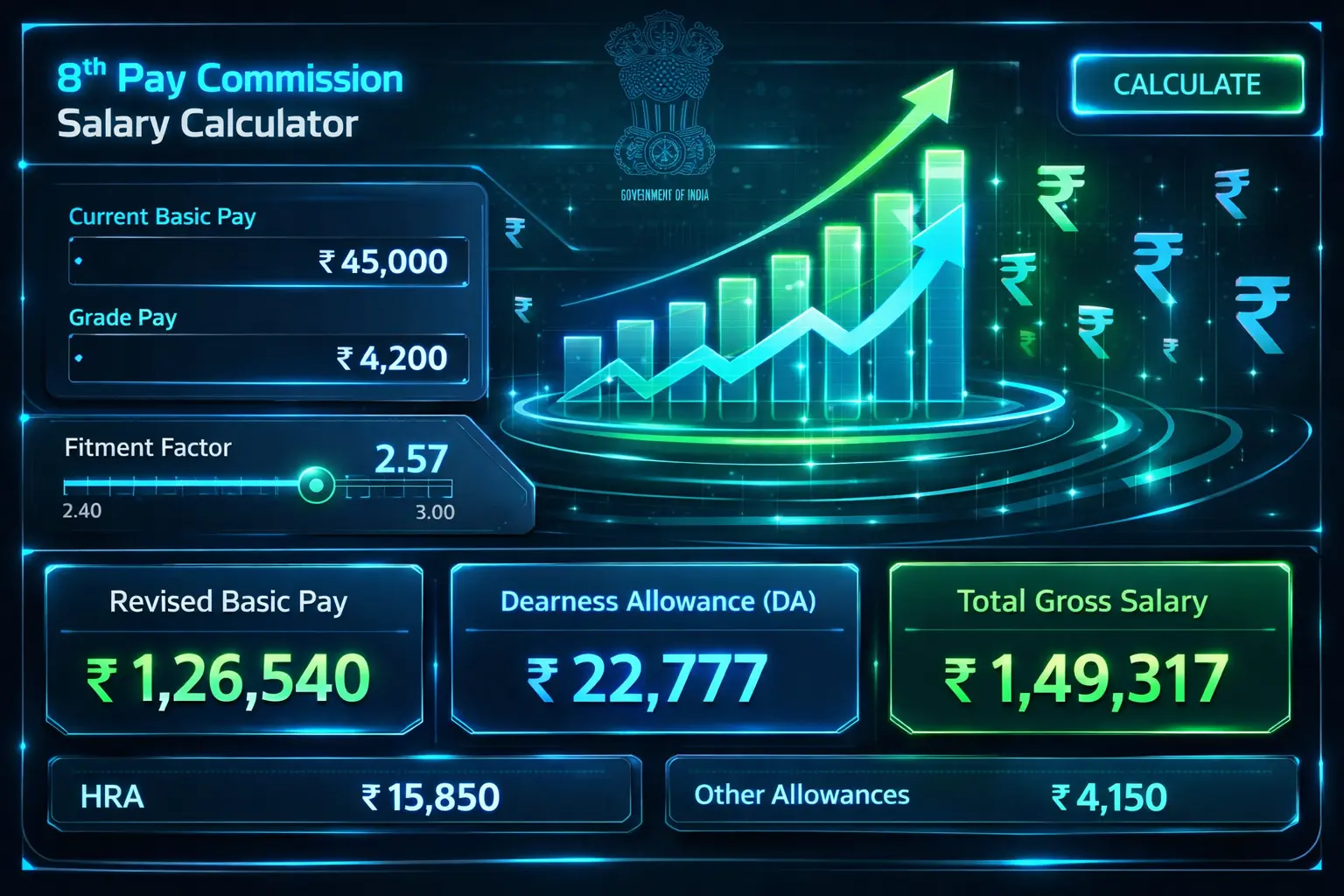
Income Tax Slabs — New Regime FY 2025-26
| Annual Income Range | Tax Rate (New Regime) |
|---|---|
| ₹0 – ₹4,00,000 | NIL |
| ₹4,00,001 – ₹8,00,000 | 5% |
| ₹8,00,001 – ₹12,00,000 | 10% |
| ₹12,00,001 – ₹16,00,000 | 15% |
| ₹16,00,001 – ₹20,00,000 | 20% |
| ₹20,00,001 – ₹24,00,000 | 25% |
| Above ₹24,00,000 | 30% |
PSU & Special Category Employees
Railway Salary Calculator — 8th Pay Commission
Railway employees — including Loco Pilots, Station Masters, TTE, Engineers, and Group C and Group D staff — are covered under the same Central Government pay structure as other departments. Their 8th CPC salary is calculated using pay levels from Level 1 to Level 18, with the same city classifications for HRA. However, Railway employees also receive Running Allowance and Night Duty pay, which are calculated separately and added to the gross salary figure. The calculator treats Railway as a Central Govt department with basic pay, PRP, and Bonus included in the annual projections.
IDA Pay Scale for PSU Employees (ONGC, NTPC, Coal India)
Employees of Maharatna, Navratna, and Miniratna PSUs like ONGC, NTPC, and Coal India follow the IDA (Industrial Dearness Allowance) pay scale, which is different from the CDA pattern used by regular central government employees. IDA is linked to the Consumer Price Index (CPI) and currently stands at 140–150%, revised quarterly. PSU executive grades from E0 to E9, plus board-level positions, also receive cafeteria perks amounting to 35% of basic pay. HRA for IDA employees is structured as 24% (X class), 16% (Y class), and 8% (Z class), while EPF contributions run at 12% each from employee and employer sides. PRP (Performance Related Pay) typically adds 10–20% annually on top of the base salary.

IIT, NIT & Central University Faculty
Faculty members at IITs, NITs, IIMs, IISc, IISERs, IIITs, and NITIE follow a separate Academic Grade Pay (AGP) system under UGC pay scales. Academic Grade Pay at Level 12 under the AGP structure places senior professors at the highest university pay bands. In addition to standard allowances, medical faculty receives NPA (Non-Practising Allowance) at 20% of basic pay, while hospital-based staff may also be eligible for HPCA and PCA. Institutions like SPA, NIFT, CIT, SLIET, and NITTR follow similar UGC-linked salary structures, all of which are expected to be revised proportionally under 8th CPC guidelines.
Economic Impact of the 8th Pay Commission
Pay revisions of this scale have a significant economic impact beyond just the government wage bill. When over 50 lakh employees and 65 lakh pensioners receive a combined salary hike pushing the total outgo to approximately ₹1.8 lakh crore, the resulting boost in household spending and consumption creates meaningful momentum in aggregate demand across the Indian economy. Higher purchasing power in the hands of government employees stimulates sectors like real estate, automobiles, consumer electronics, and retail — all of which directly respond to urban income growth.
At the same time, policymakers must balance the pay revision's fiscal discipline implications. Historically, governments have used pay commission revisions thoughtfully to calibrate inflation impact while maintaining macroeconomic welfare. The 8th Pay Commission, with its careful attention to inflation-linked cost of living — including room rent, daily-use items like rice and water, and transport — aims to achieve this balance. The commission's final report, expected to run 500–600 pages like the 7th CPC's 700-page document, will reflect months of deliberation across factors spanning competitive salaries to retain skilled workers, private sector benchmarks, and political factors unique to the governance environment of 2026.