
DA Arrear Calculator
7th CPC DA Calculator
& DA Arrear Calculator 2026
Calculate your exact month-wise Dearness Allowance arrear from the 58% → 60% hike of January 2026. Enter your Basic Pay and get the complete rupee breakdown instantly.
🕐 Last Updated: June 2026 | Based on AICPI-IW data up to April 2026
Whenever the government revises Dearness Allowance — as was done recently when DA was increased from 58% to 60% in January 2026 — Central Government employees receive arrears for the months in which the revised DA had not yet been added to their salary. This calculator computes your exact arrear month-by-month, so you can be fully prepared for the amount arriving in your payslip. Simply enter your Old DA%, New DA%, number of pending months, and Basic Pay — the calculator below does the rest.
The January 2026 DA hike specifically brought arrears for three months — January, February, and March — since Cabinet approval came in April 2026. A Level 7 employee with a basic pay of ₹44,900 received a lump-sum arrear of ₹2,694 this time — but your actual figure depends on your pay level and the number of pending months. Use this calculator to find that exact number.
📘 What Is Dearness Allowance (DA)?
Dearness Allowance is a cost-of-living adjustment paid to Central Government employees and pensioners to ensure that purchasing power is not eroded by inflation. It is a fixed percentage of basic pay and is revised twice a year — effective 1 January and 1 July.
DA is calculated based on the All India Consumer Price Index for Industrial Workers (AICPI-IW), published monthly by the Labour Bureau, Ministry of Labour and Employment. Earlier, this index was calculated on base year 2001, but from September 2020, a new series with base year 2016 = 100 was officially adopted, aligning with the 7th Pay Commission pay structure.
As of January 2026, the DA rate is 60%. This means that for an employee with a basic pay of ₹44,900, the monthly DA component works out to ₹26,940. This protects real value and compensates for changes in the cost of living. Pensioners receive this same allowance under the name Dearness Relief (DR) — at the same rate and on the same revision schedule.
DA is taxable income, and NPS contributions are also calculated at 10% of Basic + DA. When DA crosses certain thresholds, other components like HRA rates and the gratuity ceiling are also revised — making DA not just a standalone allowance, but a key driver of the entire salary structure.

💰 What Are DA Arrears?
DA arrears are the back-pay you receive when there is a gap between the effective date of a DA revision and the date it is actually implemented. Whenever the Cabinet approves a DA hike, the difference for the months before the notification is added as a lump sum to the salary.
For January 2026 — DA was officially revised from 58% to 60% effective 1 January 2026, but the Cabinet notification came on 22 April 2026. This means January, February, and March 2026 — 3 months — were paid as arrears in the April salary. The formula is straightforward:
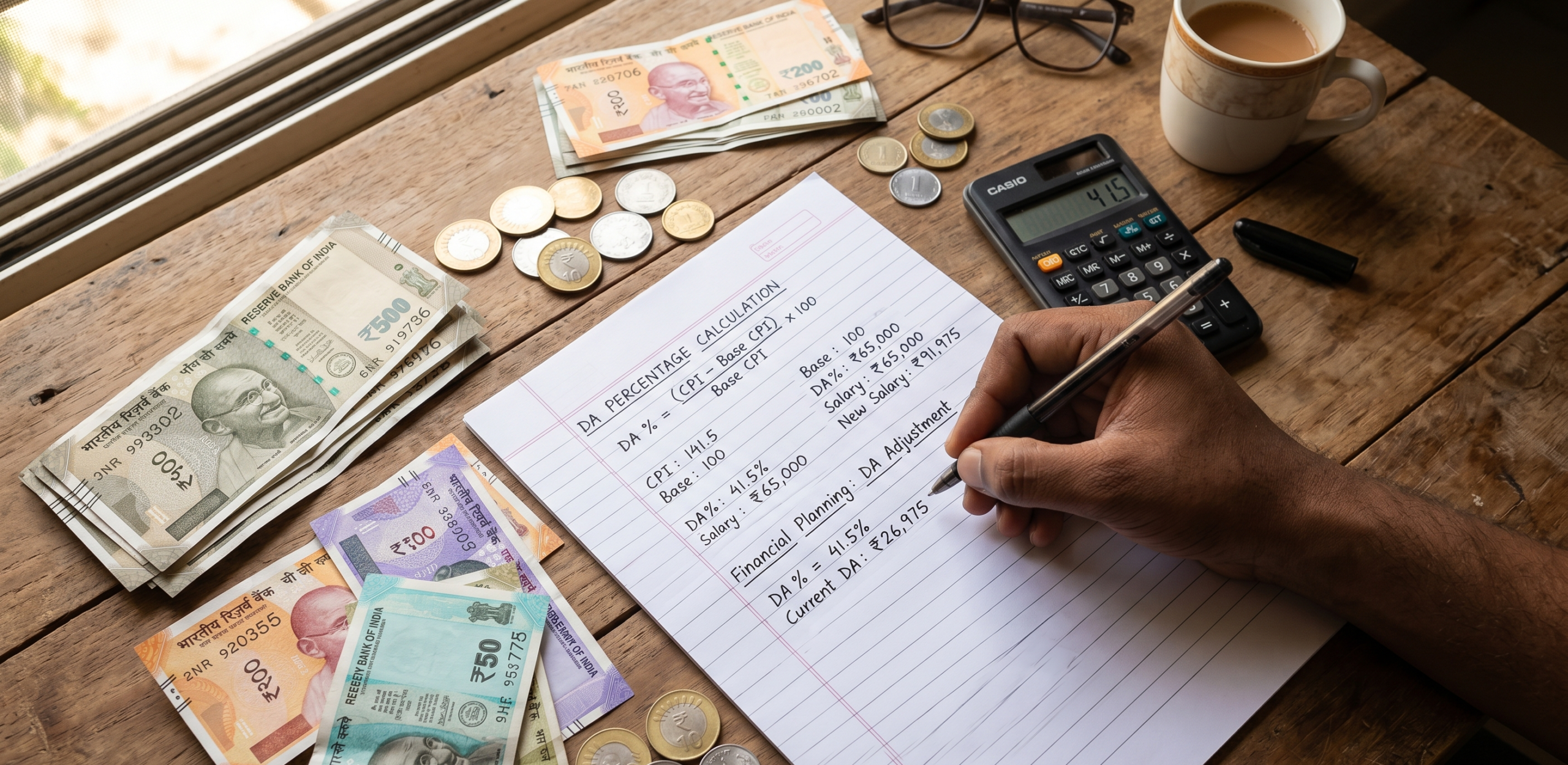
Monthly Arrear = Basic Pay × (New DA% − Old DA%)
Total Arrear = Monthly Arrear × Number of Pending Months
Example:
Basic Pay: ₹44,900 | Old DA: 58% | New DA: 60% | Months: 3
= ₹44,900 × 2% × 3 = ₹2,694
One important point — DA arrears do not attract NPS deduction. NPS is deducted only on regular monthly DA, not on the lump-sum arrear payment. However, the arrear is certainly taxable as salary income — in the year it is received, regardless of which period it relates to. We cover Section 89(1) relief in detail further below.
📊 DA Revision History — 7th CPC (2021–2026)
The table below provides a complete revision history of DA under the 7th Pay Commission. Note that when DA reached the 50% milestone, HRA thresholds and certain Transport Allowance components were revised — this was an important trigger point under 7th CPC rules. When the 8th CPC is implemented, the DA counter will reset back to 0%.
| Effective Date | DA Rate | Increase | DA on ₹44,900 Basic |
|---|---|---|---|
| July 2021 | 31% | +3% | ₹13,919 |
| January 2022 | 34% | +3% | ₹15,266 |
| July 2022 | 38% | +4% | ₹17,062 |
| January 2023 | 42% | +4% | ₹18,858 |
| July 2023 | 46% | +4% | ₹20,654 |
| January 2024 | 50% | +4% | ₹22,450 |
| July 2024 | 53% | +3% | ₹23,797 |
| January 2025 | 55% | +2% | ₹24,695 |
| July 2025 | 58% | +3% | ₹26,042 |
| January 2026 Current | 60% | +2% | ₹26,940 |
| July 2026 (Expected) | 62–63% | +2–3% | ~₹27,838–₹28,287 |
🧮 How to Calculate DA Arrears — Step by Step
Calculating DA arrears is actually quite straightforward — just follow these steps. If you received an increment during the arrear period, use the revised basic pay for the months after the increment.
Note the DA rate that was in effect before the arrear period. For the January 2026 hike, this was 58%.
The revised DA rate approved by the Cabinet. For the January 2026 revision, this is 60%.
Count the months from the DA effective date to the date of actual payment. For the January 2026 hike paid in April 2026, this was 3 months.
Find your current basic pay from the 7th CPC pay matrix. The minimum basic pay for Level 7 is ₹44,900.
Formula: Basic Pay × (New DA% − Old DA%). Example: ₹44,900 × 2% = ₹898 per month.
Monthly arrear × number of months = total lump sum. ₹898 × 3 = ₹2,694 total arrear.
This arrear is taxable as income in the year it is received. File Form 10E for Section 89(1) relief — details are provided below.
📋 Salary Examples — DA Calculation at 60%
Below is a practical breakdown of DA and arrears for three different pay levels — covering common pay scales for SSC CGL, UPSC, Railways, and Defence personnel. These figures are based on the minimum basic pay of each level in the 7th CPC pay matrix.
July 2026 Expected Arrear — If DA Reaches 63%
If DA rises from 60% to 63% in July 2026 (a 3 percentage point hike) and the arrear period is 6 months, here is what employees at different levels can expect:
| Pay Level | Basic Pay | Old DA (60%) | New DA (63%) | Monthly Increase | 6-Month Arrear |
|---|---|---|---|---|---|
| Level 6 | ₹35,400 | ₹21,240 | ₹22,302 | ₹1,062 | ₹6,372 |
| Level 7 | ₹44,900 | ₹26,940 | ₹28,287 | ₹1,347 | ₹8,082 |
| Level 10 | ₹56,100 | ₹33,660 | ₹35,343 | ₹1,683 | ₹10,098 |
| Level 12 | ₹78,800 | ₹47,280 | ₹49,644 | ₹2,364 | ₹14,184 |

📈 AICPI-IW Data — July 2026 DA Calculation Base
AICPI-IW (All India Consumer Price Index for Industrial Workers) is the monthly inflation index on which DA is calculated. It is published by the Labour Bureau, Ministry of Labour and Employment (labourbureau.gov.in). For the July 2026 DA, the 12-month average from July 2025 to June 2026 is used.
| Month | AICPI-IW (BY 2016=100) | Running DA% |
|---|---|---|
| July 2025 | 146.5 | 58.52 |
| August 2025 | 147.1 | 58.94 |
| September 2025 | 147.6 | 59.31 |
| October 2025 | 147.7 | 59.60 |
| November 2025 | 148.2 | 59.94 |
| December 2025 | 148.2 | 60.35 |
| January 2026 | 148.6 | 60.85 |
| February 2026 | 148.5 | 61.37 |
| March 2026 | 149.1 | 61.93 |
| April 2026 | 149.9 | 62.52 |
| May 2026 | Awaited | — |
| June 2026 | Awaited | — |
The average of the 4 available months from January to April 2026 comes to: (148.6 + 148.5 + 149.1 + 149.9) ÷ 4 = 149.025. Based on this trend, the projected 12-month average points to approximately 63.97% — which when floored gives an expected DA of 63% or 64% from July 2026. The exact figure will be confirmed once AICPI data for May and June 2026 is released.
🔧 How to Use the DA Arrear Calculator
This calculator is a general-purpose DA arrear tool — you can use it for the January 2026 DA arrear as well as for the July 2026 DA revision once it is announced. Simply select the revision period and enter your details.
For the January 2026 hike, enter 58. For July 2026, the expected old DA will be 60.
For January 2026, enter 60. For estimating July 2026 arrears, enter the expected new DA of 62 or 63.
Count the months from the effective date to the actual payment date — for the January 2026 hike, this was 3 months.
Find your Basic Pay from the 7th CPC pay matrix. If an increment fell within the arrear period, account for the revised basic pay separately for those months.
A month-wise DA arrear table and the total lump-sum amount will be displayed instantly. You can screenshot or print the results for your records.
If you want a complete salary breakdown, use the 7th CPC Calculator, or find your post-deduction take-home salary using the Take Home Salary Calculator.
🧾 DA Arrear Tax Planning — Section 89(1) Relief
Receiving a DA arrear feels financially rewarding — but understanding the tax implications is equally important. A common mistake people make is thinking that arrears relating to a previous year will be taxed in that year. That is incorrect — arrears are taxable in the year you actually receive them.
DA arrears are added to salary income in the financial year the payment is received — regardless of which period they relate to.
If arrears push you into a higher tax bracket, you can claim tax relief under Section 89(1) — this is a specific government provision for exactly such situations.
To claim Section 89(1) relief, Form 10E must be submitted on the Income Tax portal before filing your ITR. This is compulsory.
No NPS deduction applies on the DA arrear lump sum. Only your regular monthly salary (Basic + DA) is used as the 10% NPS contribution base.
Here is a practical illustration: if your taxable income is ₹10 lakh — right at the edge of a tax slab — and you receive ₹25,000 in arrears, that amount could push you into the next slab. Section 89(1) redistributes this extra tax burden and provides relief. To calculate your complete post-tax salary, use the Take Home Salary Calculator.
🔗 How DA Affects Other Allowances & Pay Components
DA is not just a standalone allowance — it influences your entire salary structure. When DA increases, several other components change through a cascade effect:
HRA (House Rent Allowance)
Under the 7th CPC, HRA is divided into three city categories. In X category cities (population 50 lakh+: Delhi, Mumbai, Chennai, Kolkata, Bengaluru, Hyderabad, Ahmedabad, Pune), HRA is 27% of basic pay when DA exceeds 25% — and this rises to 30% once DA crosses 50%. Y category (5–50 lakh population) follows 18% (→ 20%) and Z category follows 9% (→ 10%) rates similarly. With DA at 60% as of January 2026, HRA is now operating at the maximum slabs.
Transport Allowance (TA)
Transport Allowance is linked to DA. Employees at Pay Level 9 and above receive ₹7,200 + DA on ₹7,200 in TPTA cities (Delhi, Mumbai, Bengaluru, Chennai, Hyderabad, Kolkata, Pune, Ahmedabad, Surat, etc.), and ₹3,600 + DA elsewhere. At 60% DA, this effectively amounts to ₹11,520 per month at the highest level.
NPS Contribution
The employee’s 10% and employer’s 14% NPS contributions are both calculated on (Basic + DA). As DA increases, the retirement corpus grows proportionally — a significant long-term benefit.
CGHS Deduction
The Central Government Health Scheme (CGHS) contribution is not directly linked to DA, but varies by pay level — Level 1–5: ₹250, Level 6: ₹450, Level 7–11: ₹650, and Level 12 and above: ₹1,000 per month.
🔮 DA Under the 8th Pay Commission
A common question is: what will happen to DA when the 8th CPC is implemented? Looking at the historical pattern across the 5th CPC, 6th CPC, and 7th CPC — in all three cases, the prevailing DA (usually between 55–65%) was merged into basic pay and a revised pay structure was determined using a fitment factor.
The fitment factor in the 7th CPC was 2.57×. Something similar is expected for the 8th CPC, though nothing has been officially confirmed yet. When the 8th CPC is implemented, the DA counter will restart from 0% — applied on the new basic pay. This transition will result in an increase in take-home pay, but the familiar DA percentage you are accustomed to will be gone.
To estimate your expected salary under the 8th CPC, you can refer to the 8th Pay Commission Salary Calculator and 8th CPC Pension Calculator.
❓ Frequently Asked Questions
This article is for informational purposes only. For official DA orders, refer to Cabinet notifications.