
Pension Calculation Results
7th Pay Commission
8th Pay Commission
increase
Disclaimer: This is an estimated calculation. It may change as per official rules.
For Central Government pensioners and employees nearing retirement, the 8th Pay Commission brings a significant revision in monthly pension amounts. This 8th CPC Pension Calculator projects your revised pension using expected fitment factors ranging from 1.82 to 2.86, and places it side-by-side with your current 7th CPC pension, so you can plan your post-retirement finances with a realistic income estimate well before the official notification arrives.
What Is the 8th Pay Commission Pension Calculator?
The 8th Pay Commission Pension Calculator is an unofficial but carefully built projection tool designed for Central Government pensioners and State Government pensioners who want to understand what their revised pension could look like once the new pay commission is formally implemented. Pension revision under a new commission usually arrives once every 10 years, and with inflation and the rising cost of living eating into the future finances of retired government employees, having a side-by-side comparison between current earnings and projected 8th Pay Commission pension genuinely helps.
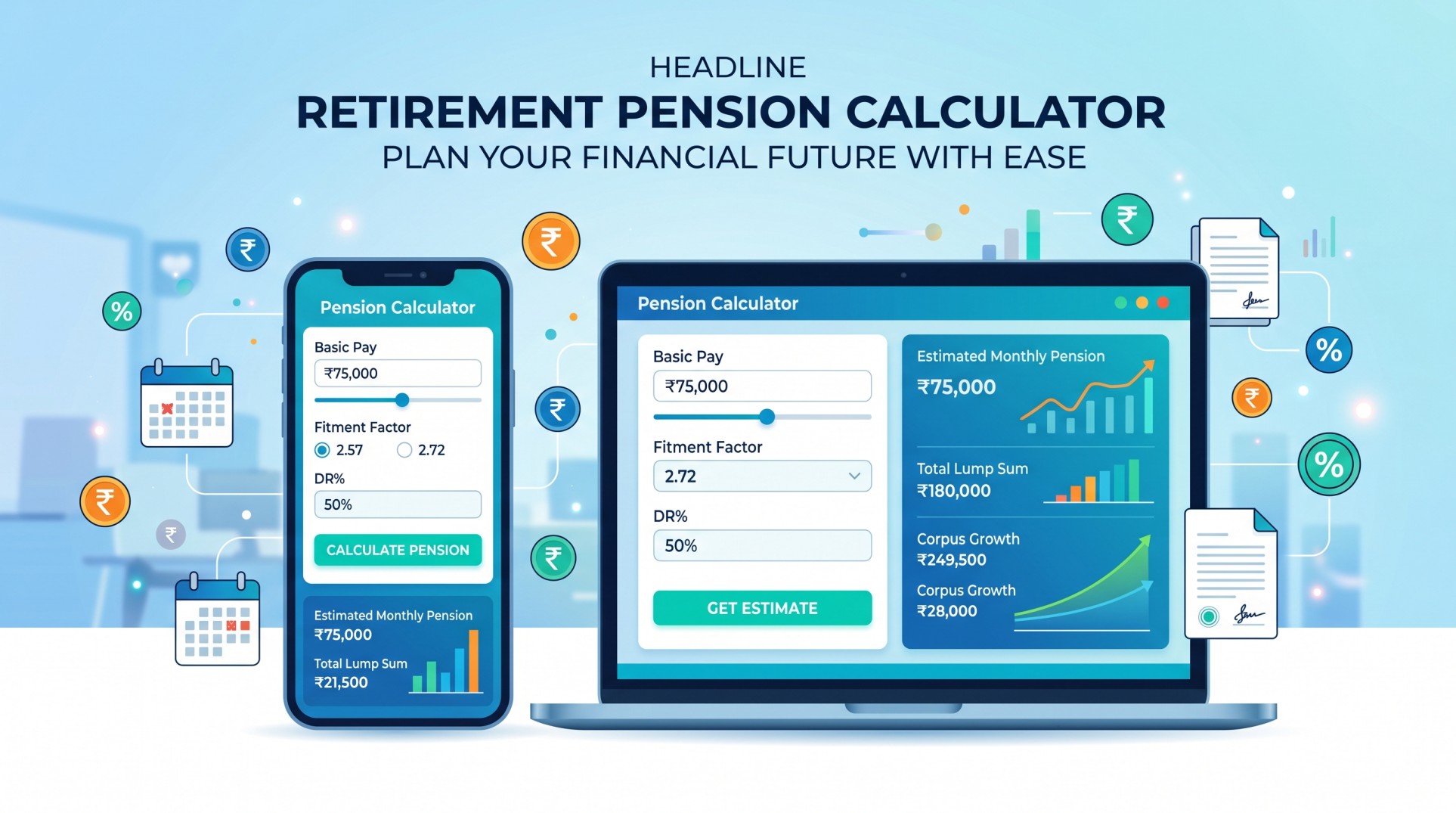
The calculator takes your Basic Pension at retirement, applies the sanctioned fitment multiplier, and layers on allowances and inflation relief such as Dearness Relief, so that the projected Gross Pension reflects what may actually land in your bank account. It also factors in additions like the Fixed Medical Allowance, since healthcare costs form a major share of a retiree’s monthly budget. This 8th CPC pension projection is built as a mathematical model, not a guess; it uses the fitment factor as the core multiplier on your current basic pension while drawing on historical patterns from the 6th Central Pay Commission and the 7th Central Pay Commission to keep the revised pay estimate grounded in precedent. Until the official notification is released, every figure here remains a what-if scenario, useful for planning but not a substitute for the eventual pension rules that will be notified by the government.
How Government Pension Is Calculated
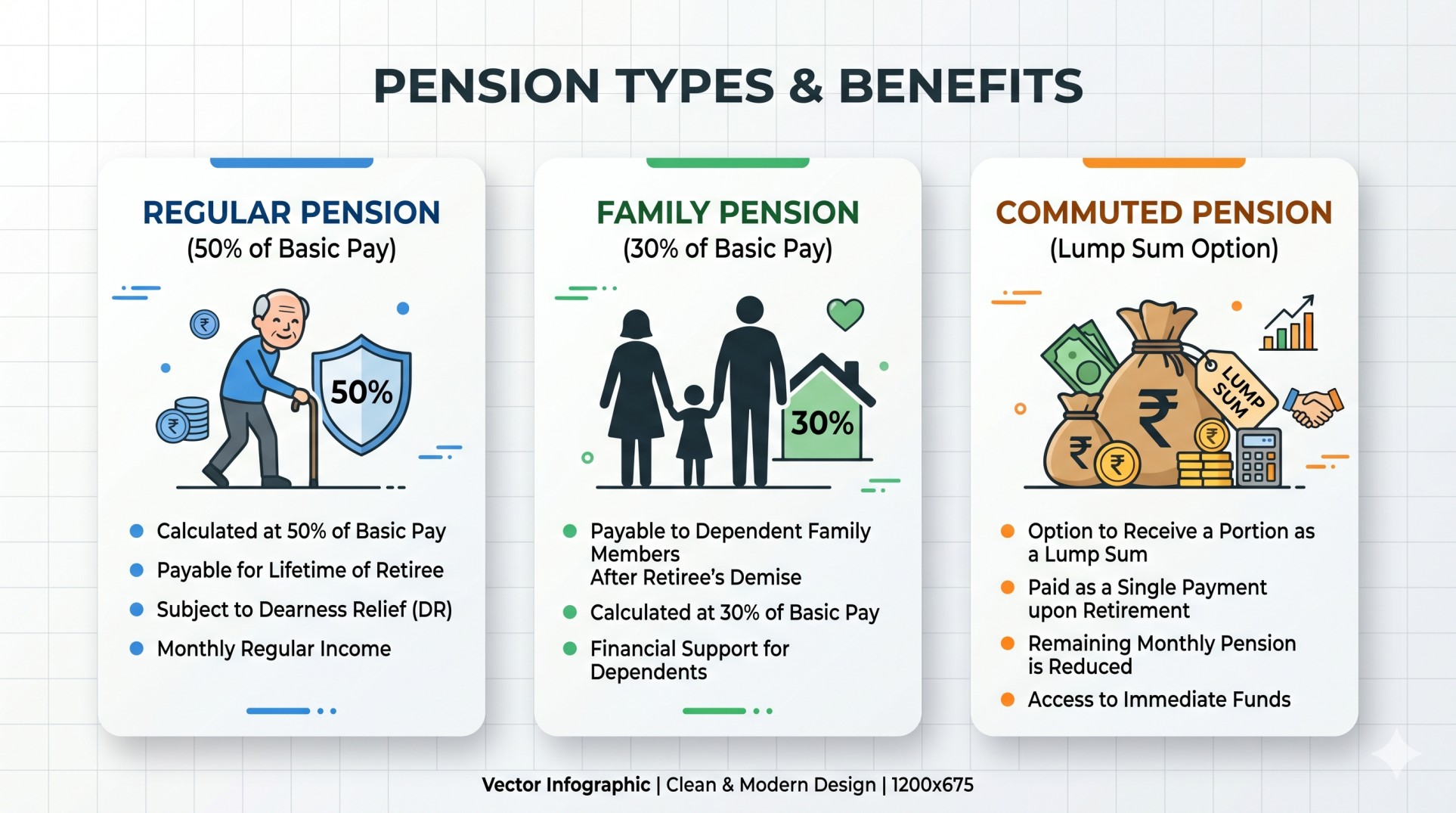
Under the Old Pension Scheme, an employee who completes a full career and retires from a government job receives a pension equal to 50% of the last drawn basic salary, before any Dearness Allowance is added on top. Take a Level 11 officer as an example: if the basic pay at retirement is ₹74,100, the base pension works out to ₹37,050. Add the Dearness Allowance that applies at the time, say 58%, and the DA component alone comes to roughly ₹21,489, bringing the total monthly pension amount to around ₹58,539.
This is exactly why the DA component matters so much for a retiree: as DA increases over time to keep pace with inflation, the effective pension amount keeps climbing even without a new pay commission. With age, this structure becomes even more relevant, since some pensioners also become eligible for an additional percentage on top of the base figure once they cross certain age thresholds, which is addressed later in this article. The formula itself, rooted in 7th CPC rules, is straightforward: half of the last drawn basic pay, plus the applicable DA calculation on that base. This pension formula has remained structurally consistent and forms the backbone of how the 8th Pay Commission’s revision will eventually be layered on top.
8th Pay Commission Latest Updates — Current Status
The 8th Central Pay Commission was officially constituted by the Government of India after the Union Cabinet approved its Terms of Reference. The Cabinet Approval came on 16–17 January 2025, with PM Narendra Modi’s government confirming the move through a PIB Release around mid-2025. The reference date for the revised pension exercise has been fixed at 1 January 2026, and the formal Gazette Notification followed on 3 November 2025.
Justice Ranjana Prakash Desai, a retired SC judge, has been named Chairperson of the commission. From the date of constitution, the commission has been given roughly 18 months to submit its report, which places the expected submission window around May 2027. Once the commission report lands, the Government Resolution, disbursement timelines, and the Department of Expenditure’s OMs covering the new Pay Matrix and arrears are expected to follow, likely stretching into Q3 2027 or Q4 2027 before pensioners and employees see the changes reflected in hand. The pension fixation rules and the final fitment factor are not yet officially notified; estimates currently circulating place the fitment factor anywhere between 1.83 and 2.86, which the Finance Ministry will narrow down once the commission’s recommendations are reviewed. Any delay in appointment of members or in finalising the Chairperson’s team could push this timeline further. Industry estimates suggest the eventual revision could push the minimum basic pay from ₹18,000 toward ₹30,000, translating to a 30–34% jump in overall salaries and pensions, at an estimated cost to the Centre of around ₹1.8 lakh crore. For the latest official updates as they are released, you can track announcements directly on the Press Information Bureau (PIB) website.
Historical Pay Commission Timeline in India
Looking back at how each pay commission has unfolded gives useful context for this 8th CPC pension estimate. The 1st CPC was set up on 01-01-1946 under Justice Srinivas Varadachariar, lifting the minimum pay from ₹55 toward levels that, across later commissions, would eventually surpass ₹2,000. The 2nd CPC followed on 01-08-1959 under Jaganath Das, delivering a hike of around 14.2%, taking minimum pay to about ₹80.
The 3rd CPC arrived on 01-01-1973 under Raghubir Dayal, with a 20.6% increase pushing minimum pay to ₹185. The 4th CPC, headed by P.N. Singhal from 01-01-1986, delivered a 27.6% hike and a minimum pay of ₹750. The 5th CPC, chaired by Justice S. Ratnavel Pandian from 01-01-1996, raised minimum pay to ₹2,550, a jump of 31%. The 6th CPC, under Justice B.N. Srikrishna from 01-01-2006, introduced a fitment factor of 1.86 and a real hike of 54%, with minimum pay touching ₹7,000. The 7th CPC, led by Justice A.K. Mathur from 01-01-2016, used a fitment factor of 2.57, a comparatively modest real hike of 14.29%, and set minimum pay at ₹18,000.
| Commission | Effective Date | Chairman | Fitment Factor | Minimum Pay |
|---|---|---|---|---|
| 1st CPC | 01-01-1946 | Justice Srinivas Varadachariar | — | ₹55 |
| 2nd CPC | 01-08-1959 | Jaganath Das | — | ₹80 |
| 3rd CPC | 01-01-1973 | Raghubir Dayal | — | ₹185 |
| 4th CPC | 01-01-1986 | P.N. Singhal | — | ₹750 |
| 5th CPC | 01-01-1996 | Justice S. Ratnavel Pandian | — | ₹2,550 |
| 6th CPC | 01-01-2006 | Justice B.N. Srikrishna | 1.86 | ₹7,000 |
| 7th CPC | 01-01-2016 | Justice A.K. Mathur | 2.57 | ₹18,000 |
| 8th CPC (Expected) | 01-01-2026 | Justice Ranjana Prakash Desai | 1.92 – 2.86 (projected) | ₹30,000 (projected) |
Now the 8th CPC, effective from the reference date of 01-01-2026 and chaired by Justice Ranjana Prakash Desai, is expected to use a fitment factor somewhere between 1.92 and 2.86 depending on which scenario plays out. Following the Gazette constitution on 3 November 2025 and the earlier Cabinet approval, the commission report is expected around May 2027, with the Government’s actual disbursement of arrears likely landing in Q3 2027 or Q4 2027, paid retroactively from the 1 January 2026 effective date. This pattern, where the headline change in the fitment factor and the effective date are announced well before disbursement, has repeated across nearly every pay commission in India’s history.
Understanding the Fitment Factor for Pensioners
The fitment factor is essentially a universal multiplier applied to your old basic pay to arrive at the revised scales relevant to pensioners. Strip away the inflation allowances and what’s left is a simple base amount calculation: if your basic pension is ₹20,000 and the fitment factor (FF) lands at 2.0, the new basic pension becomes ₹40,000. For comparison, the 7th CPC used an FF of 2.57.
For the 8th CPC, analysts and staff associations have floated six broad scenarios. On the conservative end, a fitment factor of 1.82 would represent roughly a 14% real hike, close to the government’s likely opening position and not far from the 7th CPC’s own 14.29% headline hike. A press estimate pegs a mid-conservative scenario at 1.92, translating to around a 20% increase. The Confederation of Central Govt Employees has pushed for a middle-ground figure of 2.08, implying roughly 30%. The National Council JCM’s staff-side submission goes further, asking for 2.28, a jump of around 42.5%. At the top end, some staff bodies have floated the same headline FF the 7th CPC used, 2.57, which would mean a 60.6% increase, while the maximum staff demand sits at 2.86, an Aykroyd-formula-based ask that would deliver a 78.75% jump.
On the analyst side, Kotak Institutional Equities has projected a more conservative 1.8 fitment factor tied to a minimum basic pay move from ₹18,000 to ₹30,000, while Ambit Capital has pegged its estimate around 2.46. Whichever multiplier is eventually notified, the real hike that matters to a pensioner isn’t just the headline percentage on salary — it’s the actual increase once DA at the reference date is folded in. A 1.92 FF, for instance, can translate into a real hike well above 90% over the old Basic once DA at the reference date is properly accounted for using the real hike formula described later in this article.
How Pension Was Revised in Previous Pay Commissions
Every past pay commission has approached the pension method slightly differently, and understanding that history helps make sense of the 8th CPC estimation method. Under the 6th Pay Commission, pension calculation moved through Pay Bands and Grade Pay, with Dearness Pension and Dearness Relief layered on top of the basic pension. A fitment benefit of 1.86 was applied, with a minimum benchmark acting as a safety net so no pensioner fell below a guaranteed floor.
The 7th Pay Commission simplified this considerably by switching to direct multiplication: the 6th CPC basic pension was simply multiplied by the new fitment factor of 2.57 to get the revised figure, subject to a minimum pension floor of ₹9,000 per month. For the 8th CPC estimation, most analysts are leaning on the same 7th CPC method, applying a 4-step rule anchored to the 1 January 2026 reference date. Step one merges the DA into Basic at the rate applicable on that date; step two applies the new multiplier; step three resets Dearness Relief; and step four reapplies HRA at the revised rates. Some financial analysts have proposed an alternate merge multiplier of 1.60 — derived from a 0.60 DA merge — which would still need to deliver a real hike somewhere in the 14.29% to 30–80% range that staff sides and the government’s opening position are currently negotiating. Either way, the underlying pension principle that has carried through every pay commission, multiply the base amount by the approved factor and then reapply allowances like HRA reset on the 24/16/8 scale for X/Y/Z cities, forms the pension blueprint the 8th CPC is widely expected to follow.
Key Components of 8th CPC Pension Structure
Fitment Factor and Basic Pension
At the centre of the entire 8th Pay Commission revision sits the fitment factor itself. Whatever final figure between 1.83 and 2.86 is eventually approved, it will directly decide the minimum basic pension that government pensioners receive, making this single number the most-watched part of the entire pension revision.
Dearness Relief (DR) After the 8th Pay Commission
Dearness Relief works for pensioners the same way Dearness Allowance works for active employees: it’s an inflation top-up calculated as a percentage of the basic pension, tracked against the All India Consumer Price Index (AICPI). When a new pay commission takes effect, the accumulated DR is typically merged into the new basic figure via the fitment factor, and the DR percentage resets to a zero baseline at implementation. From that fresh baseline, DR starts climbing again based on live inflation data, exactly as it did when the 7th Pay Commission reset 60% accumulated DA back to zero in 2016. Once reset, revised DR gets recalculated twice a year, acting as a continuous pension shield against inflation between commissions.
HRA Reset
House Rent Allowance is also expected to see a reset alongside the pension changes. The current 24/16/8 structure for X, Y, and Z cities is tied to DA crossing certain thresholds; once DA touches 25%, HRA steps up to 27/18/9, and at 50% DA it moves to 30/20/10. With a new commission, this entire HRA ratchet resets back to the lower starting point and climbs again as DA accumulates under the new baseline.
Pension Reforms
Beyond the headline numbers, the 8th CPC is also expected to touch broader pension reforms, including enhanced post-retirement benefits, pension parity between old and new retirees, and more timely pension disbursement. This sits alongside the ongoing shift between NPS and UPS, where a minimum pension floor of around ₹10,000 after 10 years of service has been proposed under the newer pension schemes.
Pay Matrix
Finally, a revised pay matrix is expected to reshape salary slabs and salary progression across levels, with increments simplified into a cleaner pay structure. This 8th CPC pay matrix will, in turn, become the base reference point from which every pensioner’s last drawn basic pay is calculated going forward.
Formula for 8th Pay Commission Pension Calculator
The core formula this calculator relies on is simple by design: New Basic Pension = Current Basic Pension × Fitment Factor. That single multiplier is the backbone of the entire projection. From there, the Gross Pension is built up by adding DR (Dearness Relief), which resets to 0% on Day 1 of implementation, along with FMA (Fixed Medical Allowance) where applicable.
For active employees still in service rather than already retired, the comparable salary calculation follows the same logic: New Gross Salary = (Current Basic Pay × Fitment Factor) + DA + HRA, with DA also resetting to zero at implementation just like DR does for pensioners. This shared logic, one basic pension formula for retirees and one gross pension formula running in parallel, is what keeps salary calculation and pension calculation consistent with each other across the entire 8th CPC framework.
Expected Pension Under the 8th Pay Commission
Putting the fitment factor to work on real numbers gives a clearer picture of expected pension outcomes. Under a conservative Kotak scenario using an FF of 1.8, a pensioner currently on the 7th CPC minimum basic pay of ₹9,000 could see this move toward a revised minimum basic pay closer to the ₹15,000–₹30,000 range once the broader minimum basic pay reform plays out, with the 50% pension calculation method applied on top of the new system.
| Basis | 7th CPC Minimum Pension | Projected 8th CPC Minimum Pension |
|---|---|---|
| Moderate Fitment Scenario | ₹9,000 | ₹20,500 (approx.) |
| Higher Fitment Scenario | ₹9,000 | ₹25,740 (approx.) |
| NPS / UPS Minimum (10+ years service) | — | ₹10,000 (proposed floor) |
Looking specifically at the Minimum Pension Increase, a ₹9,000 floor under the 7th CPC could move to an estimated ₹20,500 under a moderate fitment scenario, or as high as ₹25,740 under a more generous fitment factor, before Dearness Relief Adjustment is applied. Since DR resets to zero at implementation, the headline jump in basic pension is the real story here, even though take-home Gross Pension will dip briefly before DR climbs back up. Separately, under the NPS and UPS structure, a minimum pension of around ₹10,000 after 10 years of service has been discussed, with NPS contributions on revised salaries under the 8th CPC expected to flow through to higher pension corpus values for active employees who haven’t yet retired. Across the board, this represents a meaningful pension hike for pensioners once the revised pension is finally notified.
Minimum Pension and Family Pension — What Could Change?
Every pay commission pays close attention to the lowest tier of pensioners, since this is the group most exposed to inflation without a liveable standard of living buffer. Under the 7th CPC, the minimum pension floor was set at ₹9,000 per month. With the 8th Pay Commission, a fitment multiplier somewhere between 2.0 and 2.5 could push the minimum basic pension up to somewhere between ₹18,000 and ₹20,000, offering meaningful relief to low-income pensioners.
Family pensioners are treated slightly differently. Family pension is typically calculated as a percentage of the pensioner’s last drawn pension rather than as an independent figure, and existing commission rules generally use this as the primary baseline for a dependent spouse or other eligible family member. Whatever minimum baseline the 8th CPC eventually sets for regular pensioners will, in most cases, also lift the floor for family pensioners, directly affecting the monthly receipts that dependent family members rely on. The exact mechanism will only be confirmed with the official announcement, but the broader pension hike is expected to flow through to family pension recipients as well.
Why the 8th Pay Commission Matters for Pensioners
For anyone who has spent decades in active service, the transition into retirement shouldn’t mean a sudden drop in financial stability. As basic pay moves upwards for active government employees through a revised pay matrix and fresh increments, pensioners need a parallel mechanism to keep pace, and that’s precisely the gap the 8th Pay Commission pension revision is designed to close. Without periodic revision, a pensioner’s purchasing power would steadily erode while colleagues still in active service kept receiving pay hikes, undermining any sense of a dignified standard of living during retirement.
Why Pension Revision Matters in High Inflation Periods
CPI Inflation Trends, tracked through the Consumer Price Index (CPI), capture how the cost of everyday goods rises over time, and Dearness Relief exists specifically to keep pension amounts aligned with this real-world market inflation rather than letting base pay stagnate against economic reality. Rising Healthcare Costs add another layer of urgency: medical inflation in India consistently outpaces general inflation, and healthcare remains a primary expense for older pensioners, which is exactly why the Fixed Medical Allowance sits on top of the base pension to help cover quality treatment in older age. Add to this the Longevity of Retirees — people are simply living longer post-retirement than earlier generations did — and a pensioner’s retirement corpus needs to stretch further than it once did. Taken together, these three pressures explain why the 8th Pay Commission pension revision carries real weight for the financial resources retirees depend on, not just as a percentage on paper but as protection against genuine economic adjustment.
How to Use Our 8th Pay Commission Pension Calculator
Using the calculator takes only a few steps. Start by entering your Current Basic Pension as it stands under the 7th CPC; this becomes the base amount for every calculation that follows. Next, add your current DR and allowances so the tool has a complete starting picture. Then move the Expected Fitment Factor slider, which runs from 1.0 to 4.0 with 1.96 set as a reasonable default scenario, to explore different what-if outcomes.
- Enter Current Basic Pension — your 7th CPC base amount, including any current DR and allowances.
- Select Expected Fitment Factor — use the slider (range 1.0 to 4.0) to test different scenarios.
- Set Hypothetical DR — model how gross pension shifts as inflation relief accumulates post-reset.
- Toggle Fixed Medical Allowance (FMA) — include it as a standard addition if applicable.
- Click Calculate — view your comparison grid and visual chart instantly.
- Print Report — save or share your projected pension breakdown.
For employees who are not yet retired but are estimating their future pension, the calculator also accepts your grade pay level, pre-revised basic salary, a projected fitment factor, and your HRA class, so the projected net salary and expected dearness allowance are factored in correctly before the pension amount itself is calculated. You can also try our dedicated 8th Pay Commission Salary Calculator for a more detailed, salary-focused projection.
Example 8th Pay Commission Pension Projection Scenarios
Old Basic Pension: ₹18,000 | Fitment Factor: 2.3 | Old Gross (with DR): ~₹28,440
Projected New Basic Pension (8th CPC): ~₹41,400 | DR resets to 0%
Even with the temporary DR reset, the underlying percentage increase in the base structure offers meaningful financial security for lower-bracket pensioners.
Old Basic Pension: ₹25,000 | Fitment Factor: 2.57 | Old Gross (with DR): ~₹39,500
Projected New Basic Pension (8th CPC): ~₹64,250
Even after accounting for inflation eating into the higher baseline, the new DR calculations leave this mid-level pension comfortably ahead of where it started.
Old Basic Pension: ₹60,000 | Fitment Factor: 2.57 | Old Gross (with DR): ~₹94,800
Projected New Basic Pension (8th CPC): ~₹1,54,200
For high-bracket pensioners, this scale of gross increase under the multiplier model represents one of the larger absolute jumps across any pension tier.
| Basic Pay | DA | HRA (X Class, 30%) | Fitment Factor | Gross Salary | Example Posting |
|---|---|---|---|---|---|
| ₹1,00,000 | 0% | ₹30,000 | 2.6 | ~₹2,90,000 | Indian Army, New Delhi |
| ₹1,50,000 | 0% | ₹45,000 | 1.92 | ~₹3,33,000 | Indian Navy, Mumbai |
These examples use the same gross salary formula that underlies the pension calculations above, just applied to active-service pay rather than retirement pension.
HRA City Classification
House Rent Allowance depends heavily on where a pensioner or employee is, or was, posted. Cities are classified as X class, Y class, or Z class based on population: X class covers cities with a population above 50 Lakhs and carries a 30% HRA rate, applicable to metro cities like Ahmedabad, Bengaluru, Chennai, Delhi, Hyderabad, Kolkata, Mumbai, and Pune. Y class applies to tier 2 cities with populations between 5 Lakhs and 50 Lakhs, drawing a 20% rate, and includes cities such as Agra, Amritsar, Bhopal, Chandigarh, Jaipur, Lucknow, Ludhiana, Patna, and Surat. Z class covers smaller tier 3 cities and towns below 5 Lakhs population, with a 10% rate.
As discussed earlier, this entire city classification structure feeds into the HRA reset mechanism tied to DA: the 24/16/8 split under the 8th CPC implementation steps up to 27/18/9 once DA crosses 25%, and further to 30/20/10 once DA hits 50%. This HRA revision pattern will apply consistently across all three city tiers once the new commission takes effect.
Is Pension Doubled After 80 Years?
Yes, government pension rules include an age-based additional pension component that increases with longevity. A pensioner who has crossed age 80 receives an additional 20% on top of the basic pension. This additional pension percentage continues to step up with age: 30% from age 85, 40% from age 90, 50% from age 95, and a full 100% additional pension, effectively doubling the last drawn basic pay, once a pensioner reaches 100 years of age. This age-based pension enhancement under post-retirement age criteria offers genuine pension increase relief to the oldest and most vulnerable pensioners, regardless of which pay commission is currently in effect.
Benefits of 8th Pay Commission Pension Calculator
The core advantage of using this tool is Quick Pension Estimation: rather than working through formulas by hand, pensioners get instantaneous estimates of their revised pension based on assumed factors they control. This directly supports better Financial Planning, since pensioners can see how income adjustments might play out well before anything is finalised. The tool also brings Clarity on Allowances, separating out DR, FMA, and other allowances so it’s clear exactly which component is driving any change in the total figure. For employees still years away from leaving service, the same Retirement Planning logic applies, helping model how 10 years of additional contribution and revised pension benefits could shape eventual retirement financial planning. Altogether, these pension calculator benefits combine into a single number that’s far more useful for income estimation and financial projection than guessing at a future percentage increase.
Who Will Benefit from the 8th Pay Commission Pension Revision?
The pool of beneficiaries here is wide. Central Government retirees and Civil pensioners across central ministries and departments form the largest group. Defence pensioners, who also benefit from separate OROP rules layered on top of standard CPC revisions, are another major category, alongside Railway pensioners and Postal department retirees. Family pension beneficiaries, who receive a deceased employee’s pension under defined rules, are equally covered. While the 8th CPC is built around Central Government employees, many State governments have historically followed central pay committee recommendations with their own modifications, meaning a large share of state-level pensioners and retirees eventually see similar pension revision benefits, even if implementation timing differs from the centre.
Financial Planning Tips for Pensioners Before 8th CPC Implementation
With arrears expected once the 8th CPC is implemented, it’s tempting to plan loans or large purchases against that future lump sum. A more cautious approach is to treat pension revision announcements and arrears calculations as conservative estimates until the 8th Pay Commission Pension Calculator’s projected fitment factor is actually confirmed in an official notification. Keeping an emergency fund in instruments with genuine liquidity, rather than tying every rupee into long-term illiquid assets, protects against any policy shift or delay in the commission’s timeline.
Given how healthcare inflation continues to push up medical costs for older pensioners, reviewing your health cover and considering top-up plans alongside existing investments is worth doing regardless of when the 8th CPC lands. Instruments like Fixed Deposits and the Senior Citizen Savings Scheme (SCSS) remain reliable for parking baseline income while you wait, and it’s worth checking how any future pension hike could affect tax liabilities once the revised numbers are notified. The broader principle is simple: don’t pre-spend anticipated arrears, keep savings flexible, and treat the eventual pension revision and its arrears payment as a bonus to retirement savings rather than money already in hand, since financial stress from over-committing against an unconfirmed number is entirely avoidable.
What 8th CPC Covers — Beyond Just Pay Revision
The Terms of Reference approved by the Cabinet in mid-2025 give this Commission a mandate that extends well past simple pay structure changes. Allowances, pension, and service conditions for Central Government employees, civilian Defence personnel, and All India Service officers all fall within scope. Pensioner restructuring is explicitly part of the brief too, tied to the same 31 December 2025 deadline associated with the revised pension exercise.
Beyond compensation, the Commission’s terms of reference review also touches Productivity-linked pay tied to performance evaluation, Holiday and leave entitlements, and Reservation policies as they relate to pay structure. While State Governments and PSUs aren’t directly bound by CPC recommendations, most have historically aligned within 6–18 months of the Centre’s announcement, meaning the eventual ripple effect could touch over 1.5 crore public-sector employees across India once these five broad areas, pay, allowances, pension, service conditions, and broader benchmarks, are finalised.
Who Is Justice Ranjana Prakash Desai?
Justice Ranjana Prakash Desai served on the Supreme Court of India until her retirement in 2014. Following her judicial career, she went on to chair the Delimitation Commission for Jammu & Kashmir between 2020 and 2022. She now holds the position of Chairperson for the 8th CPC, continuing a long-standing tradition in India where retired Supreme Court judges are entrusted with leading pay commissions; both the 5th CPC and 6th CPC, much like the 7th CPC before this one, were similarly structured with a senior judicial appointment at the helm alongside a part-time member and a Member-Secretary. The commission’s offices are based out of Chanderlok Building on Janpath in New Delhi, with the Commission reportedly operating across the 3rd floor and 7th floor of the building.
Income Tax (New Regime) Under 8th CPC
Any rise in basic pension or basic pay from the 8th CPC will naturally interact with income tax slabs under the New Regime. As of FY 2025-26, annual income up to ₹4 lakh attracts NIL tax, ₹4–8 lakh is taxed at 5%, ₹8–12 lakh at 10%, ₹12–16 lakh at 15%, ₹16–20 lakh at 20%, ₹20–24 lakh at 25%, and anything above ₹24 lakh at 30%. These figures remain tentative for future years and could shift with a DA hike, increment, or promotion pushing a pensioner or employee into a higher annual income bracket once the revised tax regime is applied to higher post-8th-CPC figures. It’s worth keeping an eye on how government employee tax deduction rules evolve alongside the broader 8th CPC rollout.
Transport Allowance (TA) Classification
Transport Allowance is structured around Pay Level and whether a posting falls within one of the 19 designated TPTA cities — Hyderabad, Patna, Delhi, Ahmedabad, Surat, Bengaluru, Kochi, Kozhikode, Indore, Greater Mumbai, Nagpur, Pune, Jaipur, Chennai, Coimbatore, Ghaziabad, Kanpur, Lucknow, and Kolkata. At Pay Level 9 and above, TA in these higher TPTA cities sits at ₹7,200 plus applicable DA, compared to ₹3,600 at other places. For Level 3 to 8, the figures are ₹1,800 in TPTA cities versus lower amounts elsewhere, while Level 1 and Level 2 see ₹1,350 and ₹900 respectively depending on DA on TA. Under the 8th CPC projection, applying the same 1.60 merge multiplier discussed earlier in the DA-merge context, transport allowance classification figures could move toward roughly ₹11,500, ₹5,800, and ₹2,200 across these respective tiers, though exact numbers will only be confirmed once formally notified.
CGHS Contribution
The Central Government Health Scheme (CGHS) contribution is also tied to Pay Level. Under the 7th CPC, Level 1–5 pays ₹250 per month, Level 6 pays ₹450, Level 7–11 pays ₹650, and Level 12 and above pays ₹1,000. Projected 8th CPC CGHS contribution figures, scaled to a higher revised contribution bracket, point toward roughly ₹400, ₹720, ₹1,040, and ₹1,600 respectively across the same levels. As with every other figure in this article, the monthly contribution for this health scheme will only be finalised through an official CGHS subscription revision once the new pay matrix is notified.
NPS Contribution
Under the National Pension System (NPS), employee contribution sits at 10% of Basic plus DA, while government contribution, the employer contribution, sits at 14%, a rate effective from 01.04.2019. Once a new Pay Commission pushes Basic to a higher figure via the fitment factor, the rupee amount of both contributions rises proportionally even though the underlying percentage stays unchanged. This means NPS contributions on revised salaries will be higher in absolute terms under the 8th CPC simply because the base they’re calculated on, NPS Tier-I balances feeding into the pension corpus, has grown. The Department of Pensions and PFRDA jointly oversee how this NPS rate and its impact on the pension fund get implemented as new basic pay figures roll out.
Frequently Asked Questions
What is the 8th Pay Commission Pension Calculator?
It’s a free, unofficial projection tool that helps retired Central Government and State Government employees estimate their revised pension under the 8th Pay Commission. By entering your 7th CPC basic pension and selecting a fitment factor, the calculator tool generates a pension estimate for planning purposes.
When will the 8th Pay Commission be implemented?
The 8th CPC was Gazette-constituted on 3 November 2025 under Chairperson Justice Ranjana Prakash Desai, with the commission report expected around 18 months later, near May 2027. Actual government implementation and disbursement likely follows in Q3 2027 or Q4 2027, with arrears backdated to the 1 January 2026 reference date. A realistic implementation timeline for most pensioners to see this reflected may stretch into late 2026 through early 2027 at the earliest for preparatory steps, with full rollout more likely across 2027.
What is the expected minimum pension after the 8th CPC?
The 7th CPC minimum pension stands at ₹9,000 per month. Estimates for the 8th CPC range from around ₹15,000 to figures as high as ₹25,740, with a commonly cited mid-range minimum pension increase estimate around ₹20,500, depending on the final fitment factor approved.
What is the expected fitment factor for the 8th Pay Commission?
The fitment factor has not been officially decided. Estimates range from 1.82, seen as the government’s likely opening position, up to 2.86, the maximum staff demand pushed by staff associations, with the Ministry of Finance expected to balance this against fiscal restraint. Analyst projections add further fitment factor estimates of 1.8 and 2.46, while the 6th CPC and 7th CPC used 1.86 and 2.57 respectively for historical comparison.
How is Dearness Relief (DR) calculated after a Pay Commission?
When a new pay commission takes effect, accumulated DR is merged into the new basic pension via the fitment factor, and the DR pattern resets to 0%. From that point, DR is recalculated twice a year based on AICPI inflation data, the same DR reset pattern seen when the 7th Pay Commission zeroed out accumulated DA in 2016.
Why does HRA reset to 24/16/8 instead of staying at 30/20/10?
HRA percentages are tied to a DA threshold staircase. Once a new commission resets cumulative DA back to 0%, HRA correspondingly resets to 24/16/8, then steps up to 27/18/9 once DA crosses 25%, and to 30/20/10 once DA reaches 50% again — the same HRA revision pattern followed under the 7th CPC.
Will pensions triple after the 8th CPC?
No. While headline fitment factor numbers may look dramatic, the actual net real hike, once accumulated DR is accounted for, is generally estimated in the 15–30% range, with some projections going up to 30–34% for overall pension growth. A full tripling of pension is not supported by any credible estimate currently in circulation.
Will pension also increase with 8th Pay Commission?
Yes. The Ministry of Finance and Department of Pension have indicated that pensions will see a corresponding increase alongside salary revisions under the 8th Pay Commission, though the exact pension rise awaits official confirmation once the commission’s report and the government’s resolution are finalised.
Is pension doubled after 80 years?
Yes. Pension doubles in stages by age: a 20% addition at age 80, 30% at age 85, 40% at age 90, 50% at age 95, and a full 100% additional pension, effectively doubling the base amount, at 100 years of age. This age-based pension enhancement applies regardless of which pay commission is currently active.
When will the 8th CPC actually take effect?
The effective date is retroactively fixed at 1 January 2026 as the reference date, though actual disbursement is more realistically expected sometime between late 2026 and 2028, once recommendations are finalised and arrears become payable retrospectively from that reference date.
How accurate is this calculator?
This calculator offers a directional estimate, generally accurate within a ±15% range, based on the DA-merge and real-hike methodology described throughout this article. Since the Fitment Factor has not been finalised through a structural redesign or notified by the Department of Expenditure, treat these figures as useful for planning conversations rather than binding financial commitments.
How much salary or pension hike is expected under the 8th Pay Commission?
Estimates for the FF itself range from 1.82 to 2.86. Once translated against the DA-merged base, most credible projections put the real hike in Basic Pay and Pension somewhere between 30% and 34%, though individual scenarios at the higher end of fitment factor estimates suggest figures could stretch closer to 90% in specific cases.
Is the 14% Government NPS contribution affected by the 8th CPC?
The 14% government NPS contribution rate itself, overseen by PFRDA and the Department of Pensions, is not expected to change as a percentage. However, since it’s calculated on Basic plus DA, the rupee amount of the employer NPS contribution will rise once the fitment factor pushes Basic higher, increasing the overall pension fund corpus over time.
Why are there so many fitment factor scenarios?
Because the final Fitment Factor is the outcome of a negotiated outcome between staff associations pushing for a higher real hike on a DA-merged base and the Ministry of Finance balancing fiscal restraint. Until the commission formally settles on one number, this fitment factor discussion will keep producing a range of scenarios rather than a single confirmed pension multiplier.