
Current DA: 60% (effective from January 2026)
Salary Breakdown
| Component | Amount |
|---|---|
| Basic Pay | ₹0 |
| DA | ₹0 |
| HRA | ₹0 |
| Transport Allowance | ₹0 |
| Gross Salary | ₹0 |
| Deductions (NPS + CGHS approx.) | ₹0 |
| Net Monthly Salary | ₹0 |
7th Pay Commission Calculator 2026
Central Government Salary — Full Breakdown
- What Is the 7th Pay Commission?
- Pay Matrix — Levels & Basic Pay
- How Is Salary Calculated?
- Formula for 7th CPC Salary
- Salary Examples
- DA / DR Orders Table
- How Much Was Salary Increased?
- Who Is Eligible?
- How to Use This Calculator
- Who Should Use This?
- Benefits of the Calculator
- 7th CPC vs 8th Pay Commission
- Related Tools
- Frequently Asked Questions
What Is the 7th Pay Commission?
The 7th Pay Commission, formally known as the 7th Central Pay Commission (7th CPC), is a committee constituted on 25 September 2013 by the Indian Government to examine the current conditions under which Central Government employees were living and surviving. The commission held extensive discussions and meetings to understand the problems faced by government officials, study the current inflation levels, and propose appropriate salary increases along with revised allowances. Its report was formally submitted on 19 November 2015, and after approval from the Indian Government, implementation began from 1 January 2016.
This detailed initiative was constituted in 2014 under the chairmanship of Justice AK Mathur, and its recommendations covered close to 47 lakh central government employees along with 52 lakh pensioners. The commission reviews and recommends changes to the salary structures, allowances, and service conditions for central government employees and pensioners every ten years. One of its most significant outcomes was the abolition of the Grade Pay system and the introduction of the Pay Level Matrix — a transparent grid system that replaced the older pay bands.
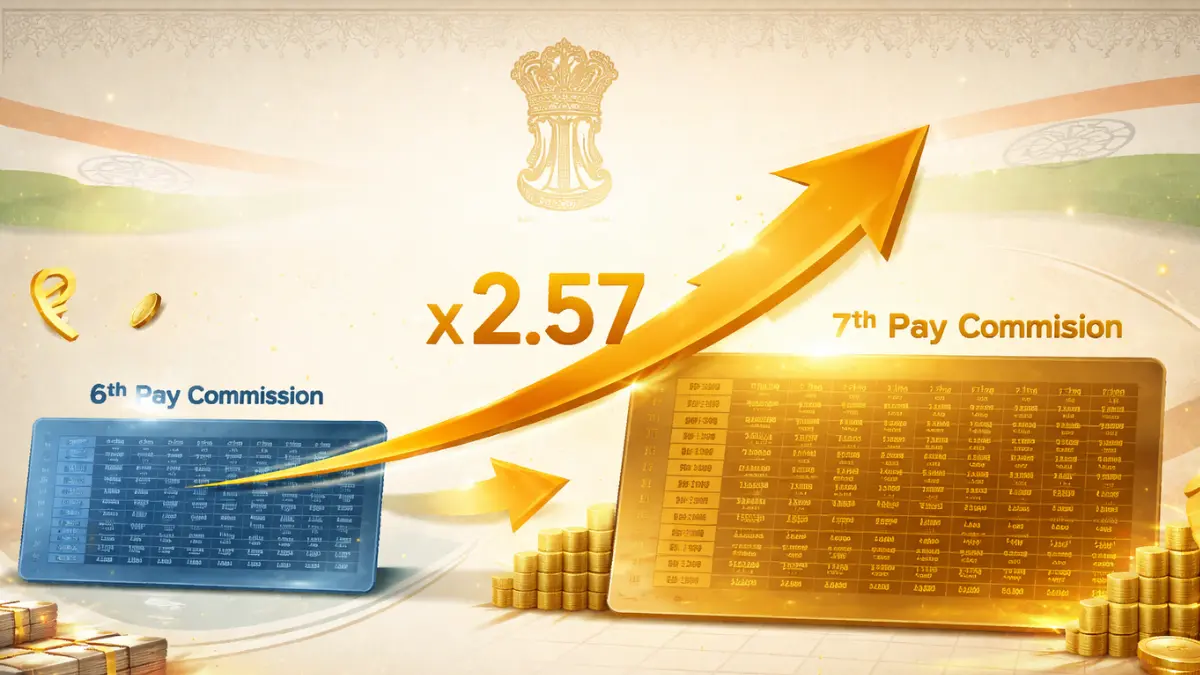
Perhaps the most impactful recommendation was the establishment of a mandatory minimum wage of ₹18,000 per month for entry-level government employees, up from ₹7,000 under the 6th Pay Commission. The 6th CPC basic pay was multiplied by a Fitment Factor of 2.57 to arrive at the new 7th CPC salary, making the transition structured and systematic across all levels.
7th CPC Pension CalculatorCalculate your Central Government pension under 7th Pay Commission rules — OPS, NPS & UPS comparison →7th Pay Commission — Important Timeline
7th CPC Pay Matrix — Levels & Basic Pay
What is a Pay Level?
The 7th Pay Commission introduced a rationalized Pay Matrix table in place of the old pay band and Grade Pay system. The matrix has 19 pay levels — from Level 1 to Level 18, with an additional Level 13A for certain specialized positions. Each level has a defined starting basic pay and a progression path with annual increments. The Pay Matrix is essentially a simple chart that allows every employee to see their current pay level and project their career span progression with clarity — no more confusing pay band calculations.
8th Pay Commission Salary Pay MatrixSee the projected 8th CPC Pay Matrix — all levels, starting basic pay & fitment factor estimates →Level-to-Post Mapping: Starting Basic Pay Table
| Pay Level | Starting Basic Pay (₹) | Maximum Basic Pay (₹) | Common Post / Role |
|---|---|---|---|
| Level 1 | ₹18,000 | ₹56,900 | MTS, Group D Posts |
| Level 2 | ₹19,900 | ₹63,200 | LDC, Peon, Driver |
| Level 3 | ₹21,700 | ₹69,100 | UDC, Constable |
| Level 4 | ₹25,500 | ₹81,100 | LDC (SSC CHSL), JSA |
| Level 6 | ₹35,400 | ₹1,12,400 | Tax Assistant, Inspector (Grade Pay 4200) |
| Level 7 | ₹44,900 | ₹1,42,400 | SSC CGL Inspector (Grade Pay 4600) |
| Level 8 | ₹47,600 | ₹1,51,100 | Assistant Section Officer (Grade Pay 4800) |
| Level 10 | ₹56,100 | ₹1,77,500 | Section Officer (Grade Pay 5400) |
| Level 12 | ₹78,800 | ₹2,09,200 | Under Secretary (Grade Pay 7600) |
| Level 13 | ₹1,23,100 | ₹2,15,900 | Deputy Secretary / Director |
| Level 13A | ₹1,31,100 | ₹2,16,600 | Specialized cadre positions |
| Level 14 | ₹1,44,200 | ₹2,18,200 | Joint Secretary |
| Level 18 | ₹2,50,000 | ₹2,50,000 | Cabinet Secretary |
What is Level 7 Salary?
Level 7 in the 7th Pay Commission corresponds to Grade Pay ₹4,600 under the old 6th Pay Commission pay band system. With the introduction of the Pay Matrix table, the Grade Pay system was removed entirely. At Level 7, the basic salary starts at ₹44,900 and progresses to a maximum basic salary of ₹1,42,400 through annual increments. This level covers key posts filled through SSC CGL — including Income Tax Inspector, Central Excise Inspector, and Preventive Officer.
What is the Maximum Salary in the 7th Pay Commission?
The maximum salary under 7th Pay Commission is at Level 18 — the highest level in the Pay Matrix. The highest basic pay here is fixed at ₹2,50,000 per month, which is the maximum pay applicable to the Cabinet Secretary and equivalent senior positions. With DA at 58%, the total gross compensation at this level exceeds ₹4 lakh per month.
Annual Increment
Every Central Government employee receives a yearly 3% increase in basic pay as an annual increment on either 1 January or 1 July — depending on their date of joining. Each level has a specific set of stages defined in the 7th CPC Pay Matrix table, and this incremental transition continues throughout a career.
How Old Grade Pay Maps to New Pay Level
Under the 6th Pay Commission, employees were placed in pay bands with a separate Grade Pay component. The 7th CPC abolished this system entirely. The mapping is: Grade Pay ₹1,800 = Level 1, Grade Pay ₹2,400 = Level 4, Grade Pay ₹4,200 = Level 6, Grade Pay ₹4,600 = Level 7, and Grade Pay ₹4,800 = Level 8. This incremental transition from Grade Pay to Pay Levels makes it simple to understand where you stand today on the Pay Matrix table.
How Is Salary Calculated? — All Components
Basic Pay
Basic Pay is the foundational salary component that drives everything else. It is determined by your Pay Level in the Pay Matrix and your current stage (number of annual increments received). All other allowances like DA, HRA, TA, and Pension are calculated as a percentage of this basic pay. Under the 7th Pay Commission, basic pay is revised and clearly defined for every stage across all levels.
Dearness Allowance (DA) & Dearness Relief (DR)
Dearness Allowance (DA) is an inflation adjustment paid on top of basic pay to help government employees cope with rising living costs — including daily expenses like rice, bread, healthcare, room rent, and other necessary goods. The DA percentage is revised biannually — in January and July — by the Ministry of Finance based on Consumer Price Index (CPI) data. When inflation rises, DA increases; when deflation occurs, DA may decrease. Dearness Relief (DR) is the equivalent of DA paid to pensioners on their basic pension, at the same rate. As of July 2025, DA/DR stands at 58%. The historical progression: Jan 2022 (34%) → Jul 2022 (38%) → Jan 2023 (42%) → Jul 2023 (46%) → Jan 2024 (50%) → Jul 2024 (53%) → Jan 2025 (55%) → Jul 2025 (58%).
Example (Level 7): ₹44,900 × 58% = ₹26,042
House Rent Allowance (HRA)
HRA compensates for accommodation costs based on the city in which the employee is posted. The city classification under 7th CPC is: X Class cities (metros — Delhi, Mumbai, Bangalore) receive HRA at 27% of basic pay; Y Class cities (major cities like Lucknow, Jaipur, Chandigarh, Patna) receive 18%; and Z Class cities (all other towns) receive 9%. When DA crosses 50%, these rates increase: X Class to 30%, Y Class to 20%, Z Class to 10% — a dual benefit that kicks in automatically.
(Post DA > 50%): ₹44,900 × 20% = ₹8,980 HRA
Transport Allowance (TA)
Transport Allowance covers commuting expenses for employees. Employees at Level 9 and above in Higher TPTA Cities receive ₹7,200 per month; those in Other Cities receive ₹3,600. At Level 1 and 2, the TA is ₹1,350 per month. DA on TA is also paid, creating a dual benefit that many employees overlook in their calculations.
Other Allowances
Beyond the main components, Central Government employees may also receive an Education Allowance for dependent children in recognized schools, and a Dress Allowance for uniformed cadres and specific departments. These are paid as per department-specific rules and are in addition to the standard components calculated in this tool.
NPS / UPS Deduction
The National Pension System (NPS) is mandatory for all Central Government employees appointed after January 1, 2004. The employee contribution is 10% of Basic Pay plus DA every month, deducted before salary is credited. The government contributes an additional 14% as employer contribution. As of April 2025, eligible employees can opt for the Unified Pension Scheme (UPS), which guarantees 50% pension on average basic pay — unlike NPS which is market-linked.
CGHS Deduction
CGHS — the Central Government Health Scheme — provides healthcare benefits to employees and their families through CGHS-empanelled hospitals. A monthly contribution of ₹500 (lower pay levels) or ₹1,000 (Level 12 and above) is deducted from salary. This covers cashless treatment including room rent and healthcare costs at hundreds of hospitals nationwide.
Income Tax Deduction
Income tax is calculated on annual gross income using FY 2025–26 tax slabs and deducted monthly as TDS from salary. You can choose the Old Tax Regime (with deductions under 80C, HRA exemption, etc.) or the New Tax Regime (lower rates, fewer exemptions). The monthly TDS ensures no large tax liability accumulates at year end.
Pension & Gratuity
Central Government employees covered under the Old Pension Scheme (OPS) receive a defined pension of 50% of last drawn basic pay upon retirement, along with Gratuity. Under NPS, the pension is market-linked based on corpus accumulated. Under UPS (from April 2025), a guaranteed pension equivalent to 50% of average basic pay over the last 12 months before retirement is assured, combining the benefits of both approaches.
Formula for Calculating 7th Pay Commission Salary
The 7th Pay Commission salary calculation is based on a structured formula that accounts for the current cost of living — including the prices of essential goods like rice and bread, healthcare costs, room rent, and other necessary daily expenses. The commission applied a rigorous methodology that considered the Labour Factor (the level of hard work, mental effort, and knowledge required at each pay level) and the Time Factor (years of service and career progression) to arrive at fair pay structures across all grades.
Gross Salary = Basic Pay + DA + HRA + TA + Other Allowances
DA = Basic Pay × 58%
HRA = Basic Pay × City Class % (X: 27–30% | Y: 18–20% | Z: 9–10%)
TA = Fixed slab based on pay level and city type
Net In-Hand Salary = Gross Salary − NPS (10%) − CGHS − Income Tax TDS
The standard fitment factor for 7th CPC is 2.57. In certain cadres and specific revision cases, alternate fitment values of 2.62 or 2.78 may apply. For 8th Pay Commission, the fitment factor is projected to range between 1.92 and 2.86.
HRA Rates — Before and After DA Threshold Crossings
| City Class | HRA (DA below 25%) | HRA (DA 25%–50%) | HRA (DA above 50%) — Current |
|---|---|---|---|
| X Class — Delhi, Mumbai, Bangalore | 24% | 27% | 30% |
| Y Class — Lucknow, Jaipur, Chandigarh | 16% | 18% | 20% |
| Z Class — All other cities/towns | 8% | 9% | 10% |
Salary Examples — Common Pay Levels
SSC CGL Inspector / Tax Assistant
Level 7 · Stage 1 · Y-City (Lucknow)
SSC CHSL LDC / JSA
Level 4 · Stage 1 · Z-City
Colonel Singh — Promoted Level 8
X-City (Delhi) · Fitment Factor 2.62
Section Officer / Under Secretary
Level 12 · Stage 1 · X-City (Delhi)
DA / DR Orders Table — Historical Dearness Allowance Rates
The table below lists all official Dearness Allowance (DA) and Dearness Relief (DR) orders issued by the Ministry of Finance for Central Government employees and pensioners under the 7th Pay Commission. The latest applicable rate is 58% effective July 2025, which is payable to all Central Government employees and pensioners. For the complete official pay structure and commission report, you can refer to the 7th Central Pay Commission official website.
| Effective Date | DA / DR Rate | Payable To |
|---|---|---|
| July 2025 | 58% | Central Govt Employees & Pensioners |
| January 2025 | 55% | Central Govt Employees & Pensioners |
| July 2024 | 53% | Central Govt Employees & Pensioners |
| January 2024 | 50% | Central Govt Employees & Pensioners |
| July 2023 | 46% | Central Govt Employees & Pensioners |
| January 2023 | 42% | Central Govt Employees & Pensioners |
| July 2022 | 38% | Central Govt Employees & Pensioners |
| January 2022 | 34% | Central Govt Employees & Pensioners |
How Much Salary Was Increased After the 7th Pay Commission?
One of the most notable outcomes of the 7th Pay Commission was the significant increase in minimum basic pay for Central Government employees. The minimum basic pay was revised from ₹7,000 under the 6th Pay Commission to ₹18,000 under the 7th CPC — representing a 23% increase in the minimum salary for entry-level government employees when accounting for DA merger. This was achieved by applying the fitment factor of 2.57 to the earlier salary structure, effectively absorbing existing DA into the new basic pay and raising the floor for all Central Government employees.
Who Is Eligible for the 7th Pay Commission?
The 7th Pay Commission covers all Central Government employees and Central Government pensioners, including defence personnel. Several state governments — including Uttarakhand, Uttar Pradesh, and Haryana — have also implemented the 7th Pay Commission recommendations, so this calculator can serve as a close estimate for state government officials too. However, special cadres like Armed Forces, Judges, and AICTE-scale employees have different pay structures and should consult their respective HR department or pay authority for exact figures.
How to Use This Calculator
Using the 7th CPC Salary Calculator is straightforward. Follow these steps to get your complete salary breakdown including gross salary and net in-hand amount:
- Select Your Pay Level (Level 1 to Level 14 and above)Check your payslip for the ‘Pay Level’ or ‘Level in Pay Matrix’ column. Map from old grade pay if needed: Grade Pay ₹4,200 = Level 6, Grade Pay ₹4,600 = Level 7, Grade Pay ₹4,800 = Level 8.
- Choose Your Stage (Increment Count)Your stage depends on increments received since joining. Level 7 Stage 1 = ₹44,900 (first year), Stage 2 = ₹46,300 (second year), and so on through the pay scale.
- Verify the DA Rate (Current: 58%)The calculator pre-fills DA at 58%, effective July 2025. Update manually for future projections or to model past periods. DA is the primary driver of your gross salary.
- Select Your City Type (X / Y / Z)Choose X for Delhi/Mumbai/Bangalore (27–30% HRA), Y for major cities like Lucknow/Jaipur/Chandigarh (18–20%), or Z for all other cities (9–10%). Confirm with HR if unsure.
- Click the Calculate ButtonYour seventh central pay commission salary is instantly generated — Basic Pay, DA, HRA, TA, NPS deduction, CGHS, and net in-hand salary all shown in one view.
- Read Your Detailed ResultsThe results clearly show Gross vs Net vs Deductions. Dearness Allowance, HRA class, TA, and NPS contribution are all listed separately for complete transparency.
- Download Your Report (PDF / Excel / CSV)Download your salary slip in PDF, Excel, or CSV format — ready for bank loan applications, tax records, and financial planning.
Who Should Use This Calculator?
This tool is designed for a wide range of users across government service. Whether you are an active employee, pensioner, or planning for a government career, it gives you the numbers you need:
Benefits of the 7th CPC Pay Calculator
This tool is designed to be more than a simple calculator. Here is how it helps employees, pensioners, and job aspirants make better financial decisions:
7th CPC vs 8th Pay Commission — What Changes?
With the 8th Pay Commission expected on January 1, 2026, employees and pensioners are naturally curious about what will change. The most significant shift will be the DA reset to 0% — all accumulated DA gets merged into the new basic pay upon 8th CPC implementation. Here is a clear side-by-side comparison:
| Parameter | 7th CPC (Current) | 8th CPC (Expected) |
|---|---|---|
| Implementation Date | January 1, 2016 | Expected Jan 1, 2026 |
| Fitment Factor | 2.57 (6th CPC → 7th CPC) | Projected 1.92 to 2.86 |
| Minimum Basic Pay | ₹18,000 | Estimated ₹35,400 |
| Maximum Basic Pay | ₹2,50,000 | Estimated ₹4,55,000 |
| DA at Implementation | Merged from 6th CPC | Reset to 0% (DA merger) |
| HRA — X City | 27% (30% post DA 50%) | To be re-notified |
| HRA — Y City | 18% (20% post DA 50%) | To be re-notified |
| HRA — Z City | 9% (10% post DA 50%) | To be re-notified |
Related Salary & Finance Tools
These tools work alongside the 7th CPC Calculator to give you a complete financial picture as a Central Government employee: