
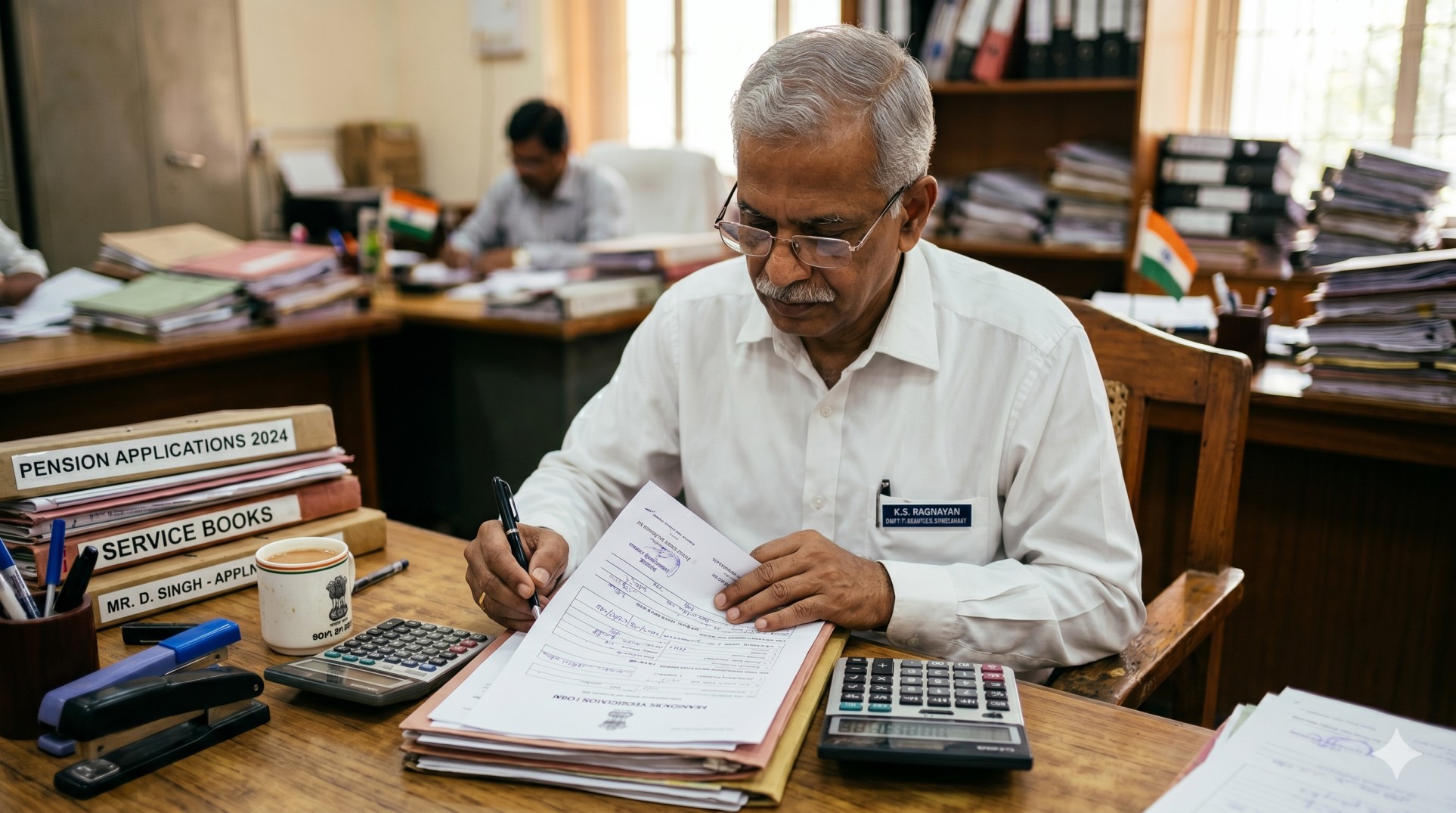
Your Pension Results
• Basic Pension = Last Basic Pay × Pension % × (Service / 33) — full benefit at 33 years
• Minimum Basic Pension: ₹9,000 per month
• Maximum Basic Pension: ₹1,25,000
• DR revised Jan & July — 60% is current rate from Jan 2026
• Approximate only — confirm with your department / CPAO for final amount
Old Pension Scheme · 7th Pay Commission · Central Government
7th CPC Pension Calculator
Estimate Your Monthly Pension, DR & Gratuity
If you are a Central Government employee who joined service before 1 January 2004 — meaning you are covered under the Old Pension Scheme (OPS) — this 7th CPC Pension Calculator shows your estimated monthly pension instantly. Qualifying service, last basic pay, Dearness Relief at 60%, and commutation options — all calculated in one place.
Who Gets a Pension? OPS, NPS, and UPS — Complete Clarity
Many government employees are confused about whether they will receive a service pension or not. The most important thing to understand — your pension eligibility depends entirely on your joining date, not your department or post.
The Old Pension Scheme (OPS) applies to all Central Government civilian personnel and Central Armed Police Forces personnel who entered service before 1 January 2004. OPS is a defined benefit scheme — meaning you receive a guaranteed monthly pension at retirement equal to 50% of your last drawn basic pay, plus Dearness Relief (DR) separately. This pension is based on the Pay Matrix and does not depend on market fluctuations. You can use our 7th CPC Calculator to quickly estimate your in-hand salary during service.
The National Pension System (NPS) applies to employees who joined on or after 1 January 2004. NPS is market-linked — your contributions are invested in a fund, and at retirement you receive the accumulated corpus. At least 40% must be used to purchase an annuity, and up to 60% can be withdrawn as a lump sum. There is no provision for a guaranteed fixed pension.
The Unified Pension Scheme (UPS), available from April 2025, is a new option for NPS subscribers. If your qualifying service is 25 years or more, UPS guarantees 50% of the average basic pay of the last 12 months as pension — serving as a bridge between OPS certainty and NPS flexibility. Check your appointment letter date or whether an NPS account exists in your name to confirm which scheme applies to you.
💡 Quick Check: Look at the joining date on your appointment letter. A date before 1 January 2004 = OPS. On or after that date = NPS. This calculator gives accurate results for OPS pensioners only.
Pension Calculation Formula — Understanding the 7th CPC Rules
Under the 7th Pay Commission, the basic pension formula is straightforward, but understanding it correctly is essential — even a small error can significantly skew your monthly income estimate. Here is a step-by-step explanation.
Basic Pension Formula — 7th CPC
Basic Pension = Last Basic Pay × 50%
(for full qualifying service of 33 years)
If service < 33 years:
Basic Pension = Last Basic Pay × 50% × (Qualifying Service ÷ 33)
Total Monthly Pension = Basic Pension + DR (60% of Basic Pension)
Last basic pay refers to the basic pay drawn on the final day of service — from the Pay Matrix. This does not include DA, HRA, or any other allowances. If an increment was earned before retirement but not yet drawn, it is also considered in the basic pay. The pension percentage is 50% for full service and is proportionately reduced if qualifying service is less than 33 years.
Dearness Relief (DR) is currently 60% and applies to the basic pension — not to the commuted portion, only to the remaining pension. DR is revised by the Department of Pension & Pensioners' Welfare (DoPPW) in January and July each year based on Consumer Price Index for Industrial Workers (CPI-IW) data. Revised rates and effective dates are mentioned in official DoPPW notifications.
📊 Worked Example — Service Pension
Last Basic Pay: ₹78,800 (Level 12, Pay Matrix)
Qualifying Service: 30 years
Pension Percentage: 50%
Reduction Factor: 30 ÷ 33 = 0.9091
Basic Pension: ₹78,800 × 50% × 0.9091 = ₹35,818/month
Dearness Relief (60%): ₹35,818 × 60% = ₹21,491
✅ Total Monthly Pension = ₹35,818 + ₹21,491 = ₹57,309/month
Minimum and Maximum Pension: After the 7th CPC, the minimum basic pension is ₹9,000 per month effective 1 January 2016. Even if the formula yields a lower amount, the government guarantees this minimum. The maximum basic pension is 50% of the highest basic pay — which can go up to ₹1,25,000 per month at the top levels of the Pay Matrix.
Minimum Basic Pension
₹9,000
Per month · w.e.f. 01.01.2016
Maximum Basic Pension
₹1,25,000
Per month (50% of highest pay)
Current DR Rate
60%
On basic pension · 2026
Full Service Required
33 Years
For 50% pension (max counted)
The proportionate reduction provision is clearly defined under Rule 44 of the CCS Pension Rules 2021. If qualifying service is less than 20 years but at least 10 years, pension is admissible but proportionately reduced. Below 10 years of qualifying service, no pension is payable — only service gratuity is given.
Pension Fixation for Pre-2016 Retirees — What is Notional Pay?
For pensioners who retired before 1 January 2016, the 7th Pay Commission provided two formulations for revision. The government decided that whichever figure is higher will be the fixed pension — implemented from 1 January 2016 and paid from that date onwards.
Option I (Basic Revision) simply multiplies the basic pension fixed under 6th CPC by a multiplier of 2.57. This is a straightforward alternative but often yields less than Option II.
Option II (Notional Pay Fixation) involves notionally fixing the retiree's pay in the 7th CPC Pay Matrix — as if they were serving in January 2016. Increments earned during service are considered at a 3% increment rate, and the corresponding notional pay at the applicable level is determined. 50% of this notional pay becomes the basic pension. Intervening Pay Commission fixation formulae are also applied when the pensioner retired several Pay Commissions ago.
📊 Pension Fixation Example — Pre-2016 Retiree
Pensioner retired: 30 May 2015
Last Basic Pay (6th CPC): ₹79,000
Basic Pension (6th CPC): ₹39,500
Option I: ₹39,500 × 2.57 = ₹1,01,515
Option II: Notional pay under 7th CPC (3 increments at Level) = ₹1,99,100 → 50% = ₹99,550
✅ Higher of the two = ₹1,01,515 → This pension will be admissible
Option II (the second formulation) is more beneficial when the employee retired long ago and missed one or more Pay Commission revisions. Government instructions clearly state that both options must be calculated and the higher figure will be taken as the pension. When the 8th Pay Commission is implemented, a similar revision process will apply — you can check the projected figures using our 8th CPC Pension Calculator.
Family Pension Calculation — A Guide for Spouse and Dependents
Family pension is paid to the surviving spouse, eligible children, or dependent parents after a pensioner's death. It is a significant financial replacement for dependents, and Dearness Relief is payable on it at the same rate as on service pension.
Enhanced family pension is paid for the first 7 years after the pensioner's death, or until the employee would have reached age 67 (whichever is earlier), and equals 50% of the last basic pay — the same as the service pension. After this period, ordinary family pension begins at 30% of the last basic pay and continues for the lifetime of the spouse or until remarriage. The minimum family pension is guaranteed at ₹3,500 per month.
Family Pension Formula
Enhanced Family Pension = Last Basic Pay × 50% (first 7 years / until age 67)
Ordinary Family Pension = Last Basic Pay × 30% (for lifetime)
Total Family Pension = Family Pension + DR (60%)
📊 Family Pension Example
Last Basic Pay: ₹78,800 (Level 12)
Ordinary Family Pension: ₹78,800 × 30% = ₹23,640
Dearness Relief (60%): ₹23,640 × 60% = ₹14,184
✅ Total Monthly Family Pension = ₹23,640 + ₹14,184 = ₹37,824/month
In terms of succession order, the surviving spouse receives pension first, then unmarried sons (up to age 25), then unmarried daughters (until marriage or earning), and then dependent parents. Eligibility rules and conditions for family pension are clearly defined in government regulations. Family pension is taxable under "Income from Other Sources" — with a standard deduction of one-third or ₹15,000, whichever is lower. For official guidelines on pensioner benefits, you may also refer to the Department of Pension & Pensioners' Welfare (DoPPW).
Commuted Pension — Understanding the Lump Sum Option
Pension commutation means surrendering a portion of your basic pension in exchange for a large lump sum payment at retirement. This is useful for immediate financial needs — building a house, funding a wedding, clearing a loan — but it results in a permanent reduction in monthly income for a fixed period.
You can commute a maximum of 40% of basic pension. The commuted lump sum is calculated using the government's Commutation Factor Table, which provides different factors based on age next birthday. The formula is as follows:
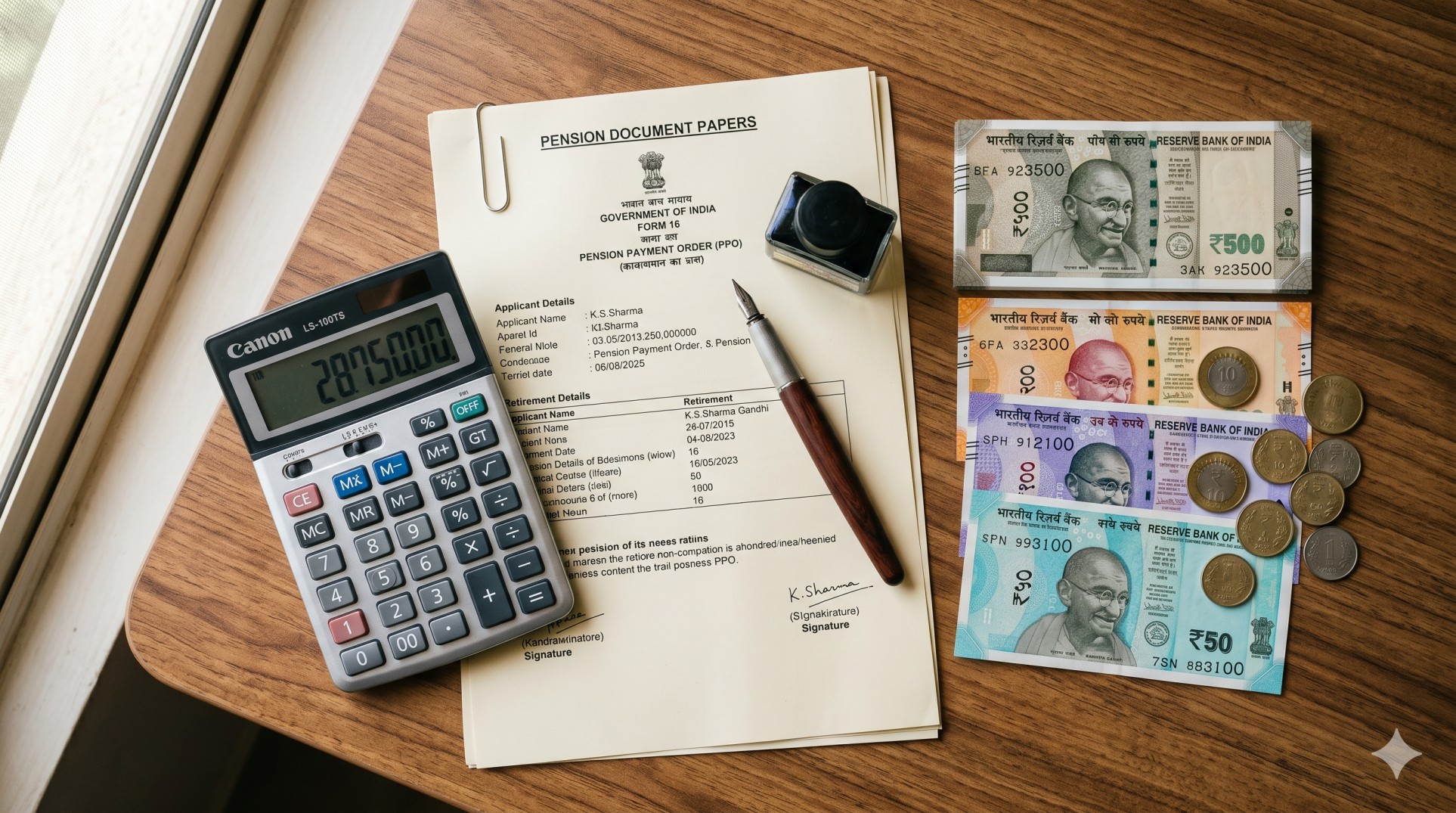
Commuted Lump Sum Formula
Commuted Amount = Basic Pension × Commutation % × Commutation Factor × 12
Reduced Monthly Pension = Basic Pension − Commuted Pension Amount
📊 Commutation Example
Basic Pension: ₹39,400/month
Commute 40%: ₹39,400 × 40% = ₹15,760/month surrendered
Age 60 → Commutation Factor: 11.87
Lump Sum: ₹15,760 × 12 × 11.87 = ₹22,44,634 (approx ₹22.8 lakh)
Monthly Pension Reduces to: ₹39,400 − ₹15,760 = ₹23,640/month
✅ Full pension restored after 15 years (commutation period complete)
The commutation period is 15 years — after which the full original pension is restored. The breakeven period is generally 12–13 years, meaning if you live beyond 12–13 years after retirement, you lose out financially on monthly income. Pensioners who benefit from CGHS coverage and secured Central Government retirement benefits should think carefully before commuting — it should only be taken when there is a specific, immediate financial need. To understand how your revised salary will look after the 8th Pay Commission, check our 8th Pay Commission Salary Calculator.
Retirement Gratuity — A One-Time Tax-Free Benefit
Retirement gratuity is a one-time lump sum payment, separate from pension, paid to the employee at retirement or to the family in case of death. Under the 7th CPC death gratuity slabs, the amount is determined based on qualifying service.
Retirement Gratuity Formula
Gratuity = Last Basic Pay × ¼ × Completed 6-Month Periods
Maximum Gratuity Ceiling: ₹20,00,000
| Qualifying Service | Death Gratuity (7th CPC) |
|---|---|
| Less than 1 year | 2× Monthly Emoluments |
| 1 year to 5 years | 6× Monthly Emoluments |
| 5 years to 11 years | 12× Monthly Emoluments |
| 11 years to 20 years | 20× Monthly Emoluments |
| More than 20 years | ½ × Emoluments × Completed 6-Month Periods (max ₹25 lakh) |
Monthly emoluments include Basic Pay and DA — gratuity is calculated on this amount. The minimum qualifying service for gratuity is 5 years. Gratuity up to ₹20 lakh is completely tax-exempt under the Income Tax Act, making it a very useful benefit at retirement.
📊 Gratuity Example
Level 7 Basic Pay: ₹44,900
Qualifying Service: 30 years = 60 half-year periods
Gratuity: ₹44,900 × ¼ × 60 = ₹6,73,500
✅ Fully tax-exempt (below ₹20 lakh ceiling)
How to Use This Calculator — Step by Step
This 7th CPC Pension Calculator is completely simple to use. Just fill in the fields below and see instant results — no manual calculation required.
Enter Basic Pay at Retirement
Type the last basic pay drawn on your final day of service. Include only basic pay — do not include DA, HRA, or any other allowances.
Enter Qualifying Service (Years)
Enter your total qualifying service years — combining duty, leave, and recognised service periods. A maximum of 33 years is considered for pension purposes.
Select Age at Retirement
Enter your age at the time of retirement. This is required to determine the appropriate commutation factor from the government's Commutation Factor Table.
Choose Commutation Percentage
Select from 40%, 30%, 20%, or 0% (no commutation). The maximum permissible commutation limit is 40% of basic pension.
Enter Dearness Relief %
Enter the current DR rate. As of 2026, the DR rate for central government pensioners is 60%. This will be updated after the 8th CPC is implemented.
Click "Calculate Pension"
With one click, your basic pension, commuted pension amount, total monthly pension with DR, and estimated family pension will all appear on screen.
⚠️ Note: This calculator provides an accurate estimate based on standard pension formulas, DR rates, and commutation rules. The actual pension may differ slightly based on official orders and individual service conditions. For the final figure, please confirm with your Pay & Accounts Office or CPAO.
Additional Pension at Age Milestones — Support in Old Age
Recognising the increased financial needs of pensioners at an advanced age, the government has made a special provision. When a pensioner reaches certain age milestones, additional pension is payable on the basic pension:
| Age Milestone | Additional Pension |
|---|---|
| 80 years | + 20% additional pension |
| 85 years | + 30% additional pension |
| 90 years | + 40% additional pension |
| 95 years | + 50% additional pension |
| 100 years or above | + 100% additional pension |
This additional pension is applied on the basic pension, and DR is payable on top of it. At age 100, the pension effectively doubles — a very thoughtful provision that ensures financial security for pensioners in their oldest years.
🔗 Related Calculators — Explore More
Frequently Asked Questions (FAQ)
To be eligible for OPS, your joining date in Central Government service must be before 1 January 2004. If you joined on or after 1 January 2004, you fall under NPS. Check your appointment letter or confirm whether an NPS account exists in your name — this will give you full clarity.
After the 7th Pay Commission recommendations, the minimum basic pension is guaranteed at ₹9,000 per month effective 1 January 2016. Even if the formula calculation yields a lower amount, the government guarantees this minimum. The maximum basic pension is ₹1,25,000 per month.
Dearness Relief (DR) is a supplement paid on basic pension to protect pensioners from inflation. It equals the DA rate for serving employees. The Department of Pension & Pensioners' Welfare announces revised rates every January and July based on CPI-IW data. The current DR rate in 2026 is 60%.
Service pension is the monthly pension paid to the retired employee — equal to 50% of last basic pay. Family pension is paid to eligible family members — spouse, dependent children, or parents — after the pensioner's death. Enhanced family pension is 50% for the first 7 years, followed by ordinary family pension at 30% for life. The two are not paid simultaneously — service pension is paid during the pensioner's lifetime, after which family pension begins.
Commutation is an option where you can take up to 40% of basic pension as a lump sum at retirement. The monthly pension is reduced by the commuted portion, but full pension is restored after 15 years. It makes sense when there is a specific, immediate financial need — building a home, clearing a loan. The breakeven period is 12–13 years; for pensioners with a higher life expectancy, commutation may not be financially advantageous.
Yes, service pension is taxable under "Income from Salaries." Family pension received by a surviving spouse or dependents is taxable under "Income from Other Sources," but a standard deduction is available — one-third of the family pension or ₹15,000, whichever is lower. DR is also included in taxable income.
NPS employees receive their accumulated market-linked corpus at retirement. A minimum of 40% of the corpus must be used to purchase an annuity for regular monthly income, and up to 60% can be withdrawn as a lump sum. There is no guaranteed fixed pension under NPS — it depends on market performance. From April 2025, the Unified Pension Scheme (UPS) is also available as an option that provides a guaranteed pension.
UPS is a new government pension option available from April 2025 for NPS subscribers. Employees retiring after completing 25 or more years of qualifying service will receive a guaranteed pension of 50% of the average basic pay of the last 12 months. It bridges the gap between the certainty of OPS and the flexibility of NPS. Employees can learn about the UPS switch process from their HR department.
A qualifying service of 33 years is required for the full 50% pension. If service exceeds 20 years but is less than 33 years, pension is calculated proportionately. Pension is also admissible for service between 10 and 20 years, but at a reduced rate. Below 10 years of service, no pension is payable — only service gratuity is given. The minimum qualifying service for pension eligibility is 10 years.
The 8th Central Pay Commission's recommendations are expected in 2026, with implementation likely from 1 January 2026. Pension revision will be based on 8th CPC Pay Matrix levels and revised fitment factors — just as the 7th CPC used a 2.57 multiplier for pension fixation. We will add 8th CPC pension options to this calculator as soon as official notifications are released.