
💰 HRA Exemption Calculator
Section 10(13A) • Old Tax Regime • Annual Amounts in ₹
This is an estimate only (Old Tax Regime). Consult a tax expert for accurate ITR filing. Rules per Income Tax Act, India.
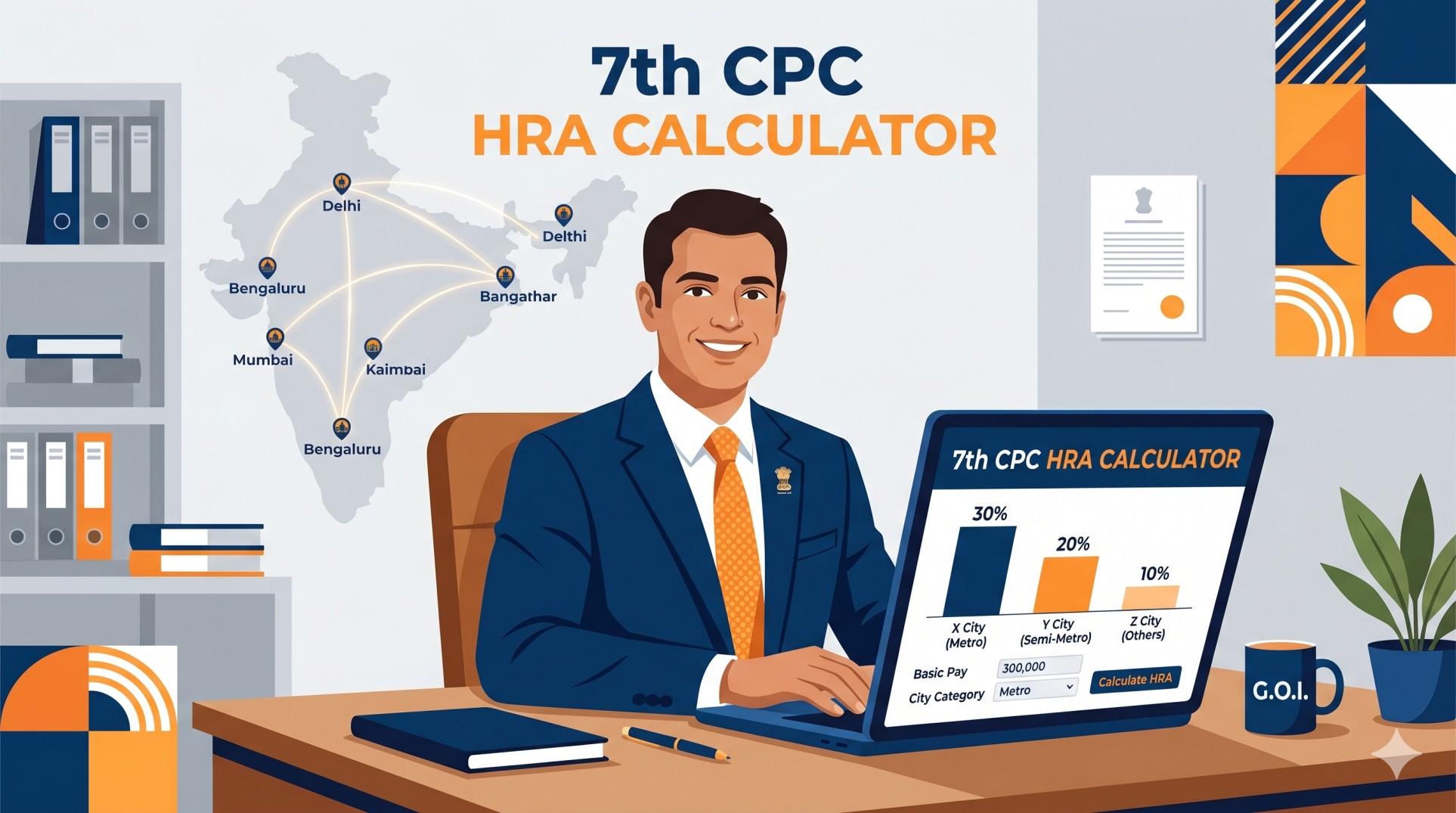
7th CPC HRA Calculator
Free Central Govt HRA Exemption Calculator
Find your exact monthly HRA entitlement and calculate the tax-free portion under Section 10(13A) — for X, Y, and Z class cities in seconds.
House Rent Allowance (HRA) is one of the biggest tax-saving opportunities for any salaried individual — especially Central Government employees living in rented accommodation. Yet most people only look at how much allowance they receive, not at which portion of that allowance actually escapes tax. This free central govt HRA calculator covers both: it first calculates your exact monthly HRA as per 7th CPC rates for your X, Y, or Z class city, and then runs the HRA exemption calculator using the three-part formula under Sec 10(13A) of the Income Tax Act to show you precisely how much of your house rent allowance is fully exempt, how much is partially exempt, and what remains taxable — all under the old tax regime.
🏠 What Is HRA Under 7th Pay Commission?
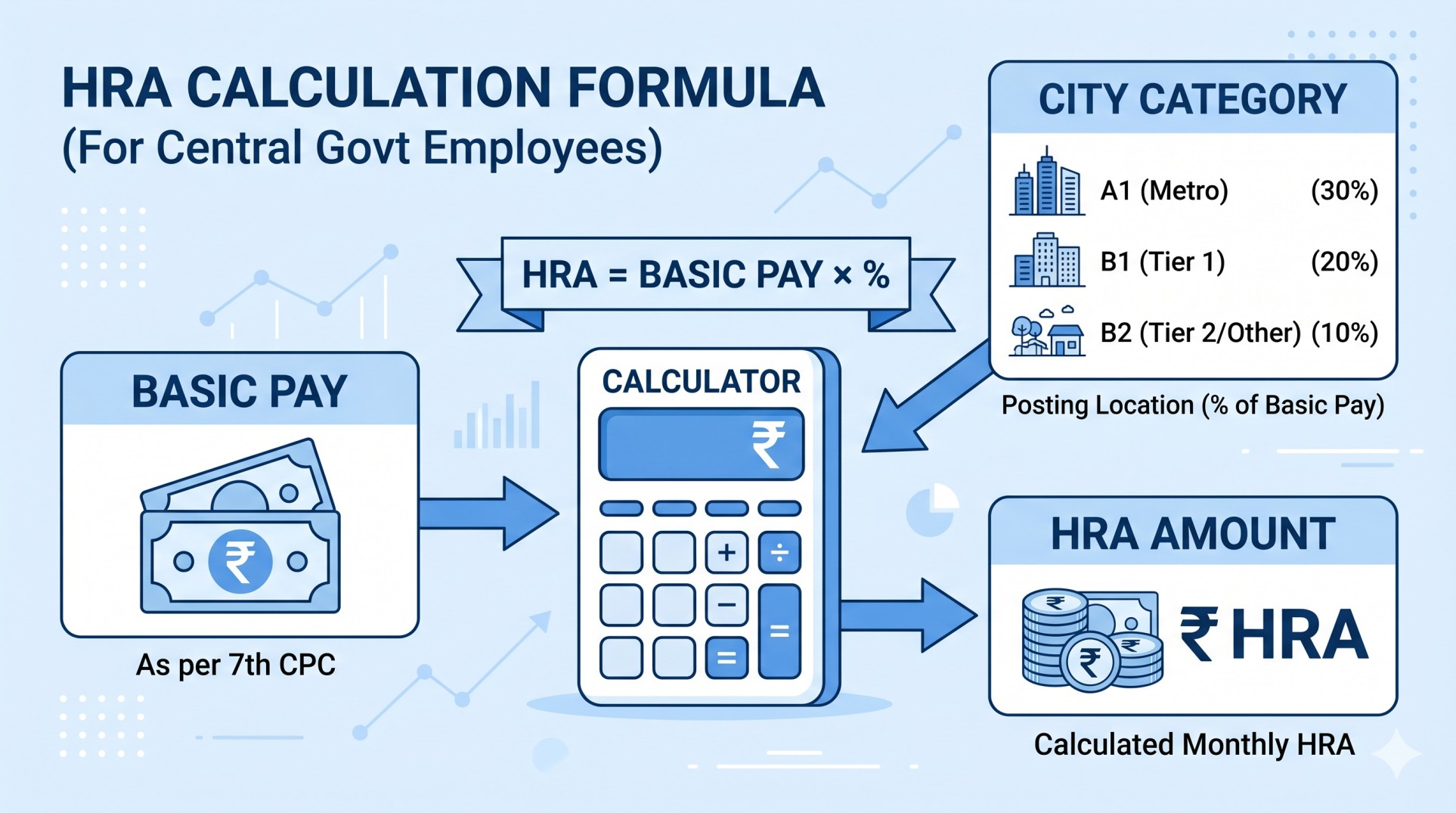
House Rent Allowance is a salary component paid by the employer to compensate a salaried individual for their rented house expenses. For Central Government employees, the 7th CPC determines the rate of HRA based on a three-tier city classification system — X class cities, Y class cities, and Z class cities — where each tier carries a distinct percentage of basic pay.
The fundamental rule is simple: HRA is only admissible if you are not staying in government accommodation. Any employee who has been allotted government quarters, or resides in employer-provided housing, does not draw HRA. Instead, a House Rent Recovery (HRR) is deducted from their salary toward the nominal licence fee for their accommodation type.
| City Class | HRA Rate (Current) | Minimum Floor | Cities Included |
|---|---|---|---|
| X Class | 30% of Basic Pay | ₹5,400/month | Delhi, Mumbai, Kolkata, Chennai, Bengaluru, Hyderabad, Ahmedabad, Pune |
| Y Class | 20% of Basic Pay | ₹3,600/month | State capitals, cities with 5L–50L population |
| Z Class | 10% of Basic Pay | ₹1,800/month | All other cities and towns |
⚡ DA Linkage in Effect: Since Dearness Allowance (DA) crossed 50% in January 2024, the enhanced HRA rates (30% / 20% / 10%) are now applicable. These are the current rates for Central Government employees as of January 2026. This DA-linked revision was pre-notified in the 7th CPC Office Memorandum dated July 7, 2017 — no separate order was needed.
The minimum floor is a government guarantee — even if 30% of your basic pay works out to less than ₹5,400 in an X-class city, you still receive ₹5,400. This prevents very junior employees at lower pay levels from getting negligible HRA. For example, an employee at Level 6, Stage 1 (basic pay ₹35,400) posted in an X-class city draws ₹10,620/month HRA, while the same person in a Y-class city draws ₹7,080, and in a Z-class city ₹3,540 — all comfortably above the minimum floors of ₹5,400, ₹3,600, and ₹1,800 respectively.
It is worth noting the distinction between 7th CPC HRA and Income Tax HRA: the pay commission framework determines what the government pays you as allowance (using X/Y/Z city classification), while Section 10(13A) of the Income Tax Act determines how much of that allowance is exempt from tax. The two frameworks use overlapping but not identical city lists, which is why understanding both is essential for accurate tax planning.
📐 HRA Tax Exemption — Section 10(13A) Formula
For a salaried individual living in rented accommodation, the portion of HRA that qualifies for tax exemption is governed by Section 10(13A) of the Income Tax Act, 1961. The mechanism is called the three-way minimum formula, and it works as follows:
Rule A → Actual HRA received from employer
Rule B → Actual rent paid − 10% of (Basic Pay + DA)
Rule C → 50% of (Basic Pay + DA) ← for X cities / Metro 40% of (Basic Pay + DA) ← for Y & Z cities / Non-Metro
Taxable HRA = Actual HRA received − Exempt HRA
Rule A ensures you cannot claim more exemption than the actual HRA your employer pays. Rule B ties the exemption to what you actually spend on rent — if you pay very low rent relative to your income, the exempt amount shrinks accordingly. The deduction of 10% of basic pay (Basic+DA) under Rule B is the Income Tax department’s way of assuming you would spend roughly that much on housing regardless. Rule C is the city-based cap: metro cities are granted a higher cap of 50% of Basic+DA, while non-metro cities are capped at 40%.
The key principle: whichever of the three amounts is the lowest becomes the tax-free portion. The rest of your house rent allowance is added to your taxable salary. If your employer pays HRA but you are not actually paying rent, both Rule B (rent − 10% = 0 or negative) and Rule C still apply, making the entire HRA fully taxable.
🚫 New Tax Regime Alert: Under the New Tax Regime, HRA exemption is not available at all. The full house rent allowance becomes taxable income. This exemption under Sec 10(13A) applies only under the old tax regime. If you have significant HRA, 80C investments, and other deductions exceeding ₹75,000 collectively, staying on the old regime is usually more beneficial.
Regarding the 2026 metro expansion update: The Draft Income Tax Rules 2026, released in February 2026, propose upgrading Bengaluru, Hyderabad, Pune, and Ahmedabad from the 40% non-metro bracket to the 50% metro bracket for income tax HRA purposes from FY 2026-27. This would raise the applicable rate under Rule C for these four cities. Until officially notified, the calculation for FY 2025-26 continues on the existing 40% rate for these cities.
For a broader understanding of how your total salary is structured alongside HRA, refer to the official Income Tax India HRA Exemption Calculator maintained by the Income Tax Department of India.
🧮 HRA Calculation Examples
The best way to understand the HRA formula is through real numbers. Each of the three examples below shows a different pay level and city, so you can see how the minimum of the three values changes across scenarios.
Example 1 — Level 7, Delhi (X Class / Metro), Monthly Rent ₹15,000
At Level 7, Stage 1, the basic pay is ₹44,900. With current DA at approximately 55%, DA works out to ₹24,695 per month, making Basic+DA = ₹69,595. Monthly HRA at 30% for X class = ₹13,470.
Notice here that Rule B gives the lowest value because the rent paid (₹15,000/month) is relatively modest compared to the employee’s income. Increasing rent paid to ₹20,000/month would push Rule B to ₹1,56,486 — and in that case, Rule A (₹1,61,640) would become the limiting factor, making almost the entire HRA tax-free.
Example 2 — Level 10, Lucknow (Y Class / Non-Metro), Monthly Rent ₹10,000
At Level 10, Stage 1, basic pay is ₹56,100. DA at 55% = ₹30,855. Basic+DA = ₹86,955/month. Monthly HRA at 20% for Y class = ₹11,220.
At ₹10,000 monthly rent in Lucknow, Rule B yields a very small exempt amount because 10% of Basic+DA (₹1,04,346 annually) nearly swallows the annual rent paid. This is a common situation where employees underestimate how much HRA becomes taxable. Paying a higher rent — say ₹20,000/month — would make Rule B = ₹2,40,000 − ₹1,04,346 = ₹1,35,654, and Rule A (₹1,34,640) would then limit the exemption.
Example 3 — Level 6, Patna (Y Class), Monthly Rent ₹8,000
Patna is a state capital and falls under Y class with a population above 5 lakh but below 50 lakh. At Level 6 Stage 1, basic pay = ₹35,400. DA at 55% = ₹19,470. Basic+DA = ₹54,870/month. HRA at 20% = ₹7,080/month — above the minimum floor of ₹3,600.
Across all three examples, one pattern is clear: Rule B is typically the binding constraint for government employees who pay moderate rent. To maximise your HRA exemption, the actual rent paid must significantly exceed 10% of your Basic+DA.
⚖️ Old vs New Tax Regime — HRA Impact
The choice of tax regime directly determines whether your HRA works as a tax-saving instrument or simply adds to your taxable salary. Under the old tax regime, the HRA exemption under Section 10(13A) is available in full — provided you live in rented accommodation and meet the rent paid conditions. Under the new tax regime, the entire house rent allowance is fully taxable regardless of how much rent you pay.
| Scenario | Old Regime — HRA Treatment | New Regime — HRA Treatment |
|---|---|---|
| Level 7, Delhi, paying ₹15K rent | ~₹96,486 exempt; rest taxable | Full ₹1,61,640 taxable |
| Level 10, Lucknow, paying ₹20K rent | ~₹1,34,640 exempt | Full ₹1,34,640 taxable |
| Employee in own house (no rent) | Full HRA taxable (Rule B = 0) | Full HRA taxable |
A practical decision rule: if the sum of your HRA exemption, 80C deductions, standard deduction, and other allowances exceeds the flat ₹75,000 standard deduction offered under the new regime, the old tax regime is likely more beneficial. Use the Take Home Salary Calculator to run a full side-by-side comparison before filing your ITR.
🛠️ How to Use This HRA Exemption Calculator
This tool handles both the 7th CPC salary component (how much HRA you receive) and the income tax HRA exemption (how much is tax-free). Enter annual figures throughout — multiply your monthly values by 12 before entering.
- Enter Annual Basic Salary — Type your annual basic pay from your pay matrix level. If your monthly basic is ₹44,900, enter ₹5,38,800.
- Enter Annual DA (Dearness Allowance) — This is calculated as a percentage of your basic pay. With DA at 55%, a basic of ₹5,38,800 gives DA = ₹2,96,340 annually.
- Enter Annual HRA Received — This is the total house rent allowance paid by your employer in the year. It should match your payslip figures × 12.
- Enter Annual Rent Paid — Enter the actual rent you pay to your landlord per year. Ensure you hold valid rent receipts and a rent agreement for documentation.
- Select Metro or Non-Metro — Choose Metro if your city falls under the income tax metro list (Delhi, Mumbai, Kolkata, Chennai — and from FY 2026-27 potentially Bengaluru, Hyderabad, Pune, Ahmedabad). All other cities are Non-Metro.
- Click Calculate — The tool applies the three-way minimum formula under Sec 10(13A) and displays your exempt HRA, taxable HRA, and the limiting rule in clear terms.
📋 Important for Tax Filing: After calculating, submit your rent receipts to your DDO via Form 12BB so the exemption is reflected in your Form 16. If your annual rent exceeds ₹1,00,000, your landlord’s PAN is mandatory and must be submitted alongside the rent receipts.
⚠️ Common Mistakes in HRA Claiming
Even employees who know about HRA exemption often leave money on the table — or create tax compliance problems — because of these avoidable errors:
-
Not submitting rent receipts to your DDO. If you don’t submit proof of rent paid via Form 12BB during the financial year, your employer cannot grant the exemption while processing TDS. You may still claim it while filing your ITR, but the discrepancy in Form 16 can trigger notices.
-
Claiming HRA while living in your own house. The HRA exemption under Section 10(13A) is strictly for rented accommodation expenses. If you own the house you live in, your HRA is fully taxable, period.
-
Missing the landlord’s PAN when annual rent exceeds ₹1,00,000. A PAN requirement applies when total annual rent crosses this threshold. Without the landlord’s PAN submitted to the employer, the HRA exemption claim may be disallowed at source.
-
Switching to the New Tax Regime without comparing HRA impact. The new regime is simpler but it makes your HRA fully taxable. Run the numbers — especially if you are in a higher pay level in an X or Y class city and pay significant rent.
-
Not knowing that rent paid to parents is valid. You can pay rent to parents, claim HRA exemption, and it is legally permissible — provided you have a written rent agreement, make payments by bank transfer, and your parents declare the rental income in their own ITR.
🗺️ HRA City Classification — X, Y, Z Cities (7th CPC)
Under the 7th CPC, city classification for HRA is based on population criteria from the 2011 Census. Cities with a population of 50 lakh and above are X class; cities between 5 lakh and 50 lakh (including most state capitals) are Y class; and everything below 5 lakh falls into Z class. Urban agglomerations are counted together, which is why Navi Mumbai, for instance, is covered under Greater Mumbai’s X class designation.
| Class | Population | HRA Rate | Min Floor | Key Cities |
|---|---|---|---|---|
| X | 50L+ | 30% | ₹5,400 | Delhi, Greater Mumbai, Kolkata, Chennai, Bengaluru, Hyderabad, Ahmedabad, Pune |
| Y | 5L – 50L | 20% | ₹3,600 | Lucknow, Jaipur, Chandigarh, Patna, Bhopal, Surat, Nagpur, Ludhiana, Vadodara, Kochi, Indore, Coimbatore, Thiruvananthapuram, Visakhapatnam, Agra, Bhubaneswar, Guwahati + 80 more |
| Z | Below 5L | 10% | ₹1,800 | All other cities, towns, and rural postings |
The full Y-class list approved under 7th CPC runs to 97 cities and includes Agra, Ajmer, Aligarh, Amravati, Amritsar, Asansol, Aurangabad, Bareilly, Belagavi, Bhavnagar, Bhopal, Bhubaneswar, Bikaner, Bilaspur, Bokaro Steel City, Chandigarh, Dehradun, Dhanbad, Durgapur, Erode, Faridabad, Ghaziabad, Gorakhpur, Guntur, Gurgaon, Gwalior, Hubballi-Dharwad, Jabalpur, Jalandhar, Jamshedpur, Jodhpur, Kanpur, Kochi, Kolhapur, Kollam, Kota, Kozhikode, Kurnool, Ludhiana, Madurai, Meerut, Mysuru, Nashik, Noida, Prayagraj, Raipur, Rajkot, Ranchi, Salem, Srinagar, Varanasi, Vijayawada, Warangal, and many more. If your city is not on the X or Y list, it is Z class by default — even major district headquarters default to Z unless they meet the population threshold.
📊 HRA Rates and DA Linkage — How DA Revision Affects HRA
One of the most important — and often misunderstood — aspects of 7th CPC HRA is its automatic revision based on DA levels. The 7th CPC Office Memorandum of July 7, 2017 pre-notified three threshold-based revisions so that Central Govt employees receive a higher HRA slab as inflation erodes the value of money:
| DA Threshold Crossed | X Class Rate | Y Class Rate | Z Class Rate |
|---|---|---|---|
| Below 25% | 16% | 8% | 8% |
| DA crosses 25% | 24% | 16% | 8% |
| DA crosses 50% (Jan 2024 ✅) | 30% | 20% | 10% |
| DA crosses 100% | To be revised per 8th Pay Commission recommendations | ||
These revisions happen automatically without a separate government notification — the thresholds and the resulting rates were all specified in the original 7th CPC OM itself. The DA crossed 50% with effect from January 2024, triggering the highest HRA slab of 30/20/10%. With the 8th Pay Commission currently in progress, fresh HRA rules will be issued once the commission submits its recommendations, likely superseding the 7th CPC DA-linkage mechanism entirely.
✅ Current Applicable Rates (January 2026): DA has been above 50% since January 2024. The enhanced rates — X: 30%, Y: 20%, Z: 10% — are in force. Your payslip should already reflect these. If it doesn’t, check with your PAO or DDO as the revision should have been implemented automatically.
❓ Frequently Asked Questions
🔗 Related Calculators
Use these alongside the HRA Calculator for complete salary and tax planning: